Continued from the August 2012 Home Page. To go to an archived version of
that page click here:
August
2012 Home Page Archive. To return to this
month's actual Home Page click on the Signal Corps
orange Home Page menu item in
the upper left corner of this page.

continuing...
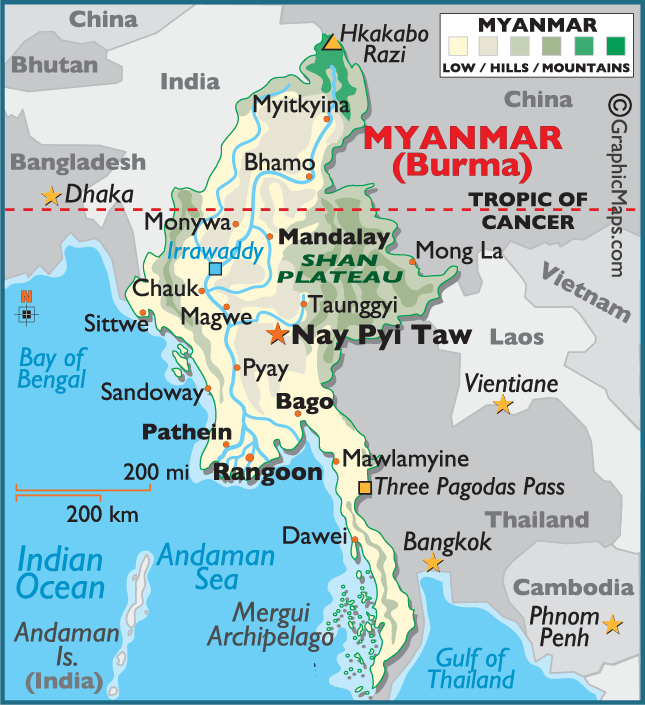 For
America’s Army, the ones who will be tasked with building
relations with the Burmese Army, this will present a
problem. Whether we accept it or not if America wants close
ties with Burma our Army is going to have to engage with the
Burmese Army just as strongly and closely as our State
Department does with Burma’s diplomats. And if that happens
the U.S. Army will be dragged into this internecine
conflict.
For
America’s Army, the ones who will be tasked with building
relations with the Burmese Army, this will present a
problem. Whether we accept it or not if America wants close
ties with Burma our Army is going to have to engage with the
Burmese Army just as strongly and closely as our State
Department does with Burma’s diplomats. And if that happens
the U.S. Army will be dragged into this internecine
conflict.
The question is, what will the U.S. Army do when their new Burmese
friends come to them for advice on how to handle the ethnic
tension that permeates the country? Perhaps more to the
point, what will they do if their Burmese Officer friends do
not come to them for advice and simply light out for the
countryside with a few regiments to slap the Atsi, Bwe or
Chin minorities back into place?
If the U.S. Army is not careful it could find itself not
only allied with but possibly responsible for the Burmese
Army reverting to its old ways.
On the good side, for the time being the military is taking
advice from the newly formed central government, with the
government actively trying to use diplomacy instead of
military force to keep the natives calm. This has brought a
few breakthroughs, as in January the government signed a
ceasefire with the rebel Kachin (a.k.a. Kayin and Karen)
ethnic group, one of the more aggressive and well armed of
the minorities.
On the bad side, in June communal violence broke out between
the Rakhine Buddhists and the Muslim Rohingya. More than
just being a religious matter, the Rohingya people not only
don’t like the Rakhine but also hate both the central
government and the military. The reason? Back in 1982 the
military leaders at that time collectively revoked the
Rohingya’s citizenship. Talk about a reason to want to be
separate from the nation the world tells you that you are a
part of.
One might ask the question then, if today was five years
into the future and the U.S. Army had already built solid
ties with the Burmese Army… such as hosting Burmese Officers
at U.S. facilities for exercises, education, training and
the like… what advice and help would we give to them in
trying to help them bring the Rohingya back into the fold?
Our answer would be one word: COIN. More to the point, we
would hope that by five years down the road from today the
U.S. Army would have already graduated a number of
COIN
qualified Burmese Officer leaders who would by then have
been well along the road towards implementing this “weapon
system” with the dissatisfied tribes, long before any of
them took to the jungles to mount an insurgency campaign.
 This
then is what we meant when we began this article by speaking
of the need for U.S. Army Officers to understand the lay of
the land of the nations of Asia that the ‘rebalance
strategy’ is impelling us to engage with. Unless we know who
they are, what they are, and what problems they are
facing—and plan for ways to help our new friends resolve
those problems—we won’t be able to effectively bring these people into
our embrace… neither our military embrace, diplomatic
embrace, nor the embrace of our national values.
This
then is what we meant when we began this article by speaking
of the need for U.S. Army Officers to understand the lay of
the land of the nations of Asia that the ‘rebalance
strategy’ is impelling us to engage with. Unless we know who
they are, what they are, and what problems they are
facing—and plan for ways to help our new friends resolve
those problems—we won’t be able to effectively bring these people into
our embrace… neither our military embrace, diplomatic
embrace, nor the embrace of our national values.
Ethnic tension aside, as it comes together to build
relations with the Burmese Army the U.S. Army’s role in
Burma won’t end there. We are not the only country to notice
that Burma is making moves suggesting it wants to be part of
the world again. In May Manmohan Singh, the Prime Minister
of India, paid the country’s first official visit to Burma
since 1987. While there he just happened to sign 12
agreements to strengthen trade and diplomatic ties,
including a couple that specifically provided for border
area development supported by an Indian line of credit.
So the question is, how good are our relations with India?
Is India’s sudden interest in Burma a problem for us or a
benefit? Students of India will remember that India has that
strange appendage that the British left them with, above and
to the right of Bangladesh. An appendage that is a part of
their country but seems not to be part of it at all. Looking
at it reminds one of that saying that Maine farmers utter
with their Downeast accent when you stop and ask them for
directions: welp… you caint get theah from heah.
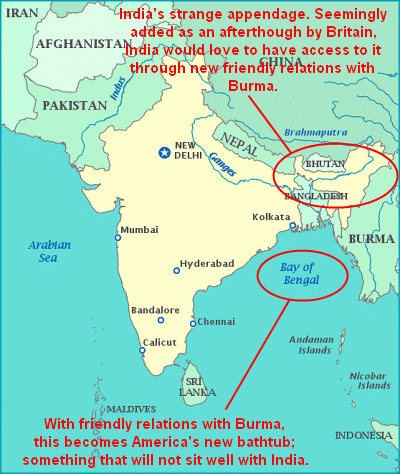 Fortunately
for India, but perhaps not so fortunate for us, with new
relations with Burma India will finally be able to get there
more easily via Burma than via its own back yard, thus
avoiding the need to keep things on an even keel with either
Bangladesh or China. And considering that India and China
still on occasion raise their voices over their common
border, having an India that can flex its muscles when it
wants to might not prove well for America, especially if we
are both shoving our elbows in an attempt to be the first
country to work its way through Burma up to the border with
China.
Fortunately
for India, but perhaps not so fortunate for us, with new
relations with Burma India will finally be able to get there
more easily via Burma than via its own back yard, thus
avoiding the need to keep things on an even keel with either
Bangladesh or China. And considering that India and China
still on occasion raise their voices over their common
border, having an India that can flex its muscles when it
wants to might not prove well for America, especially if we
are both shoving our elbows in an attempt to be the first
country to work its way through Burma up to the border with
China.
Also, from India’s perspective, having the U.S. on its
eastern border as well as its western (via Afghanistan) may
not sit well with India’s military. For example, in addition
to the U.S. gaining a land presence on India’s eastern flank
via a new relationship with Burma, it will now have a chance
to extend its presence into what were previously considered
(by India) as its home waters. Specifically, without a
foothold in either Bangladesh or Burma the U.S. has been
unable to make its presence known in the Bay of Bengal.
Unlike the Arabian Sea, which the U.S. military has treated
as an active zone of presence for many years, the Bay of
Bengal has been something that India has considered as its
own backyard. If America moves into Burma and gains a
military presence there, this is bound to result in the U.S.
Navy extending its presence to the Bay of Bengal. Without
doubt this will not sit well with India.
One can see than that while there have been no points of
confrontation between the U.S. and India to date, that
doesn’t mean there won’t be any in the future. Remember, in
the past the U.S. and India rarely ran across each other.
Now we will both be vying to become Burma’s BFF. That is
bound to bring some tension.
Then there is China itself. As evidenced by the quick trip
that Chinese Vice President Xi Jinping took to Burma in
November of 2011, where he offered to boost military ties
with the country days ahead of U.S. Secretary of State
Hillary Clinton's historic visit to Burma, the U.S.' efforts
to begin building ties between our military and Burma's
seems to make Beijing very, very jittery. And while in
public China's leaders may say otherwise and act like it
could care less if America engages with the newly opened
Burma, deep down inside it is petrified of having the U.S.
box it in via one more country. And this one right on its
southern doorstep.
From America’s perspective engaging with Burma is critical
to our national defense. If there is one lesson that we
should have learned by now it is that our past decade of
“strategic neglect” as regards the rise of China’s military
has left us almost wholly unable to counter their new
assertiveness. The net result is that since we failed to
deal with China when we could have, now we are forced to
fall back on the threadbare concept of a “strategy of
containment.” In our view a strategy of containment is no
strategy at all. It’s simply a phrase that makes us feel
better when there is nothing else we can do to change the
outcome of an imbalance between our country and another,
something we allowed to happen on our watch. Containment is
little better than closing our eyes and hoping the problem
goes away.
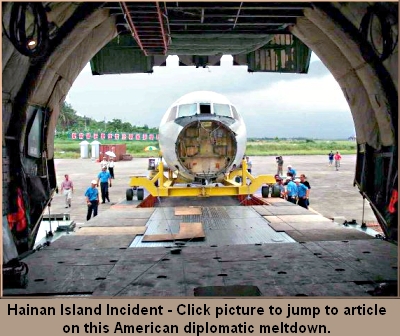 So
how did we get here? For nearly two decades America's
leaders talked up the idea of engagement with China but
never backed up our talk with muscle when China gained the
upper hand via cunning, deceit and chicanery … not with
trade, not with monetary policy, not with tariffs, not with
exchange rates, not with price fixing, not with pirated
intellectual property, not with North Korea, not with
China’s stalling moves in the UN, and certainly not when our
militaries bumped heads (think: the 2001 Hainan Island
incident). So, since we don't seem to have the diplomatic
courage to stand up to them, absent our ability to occupy
another square on the chess board, what makes us think that
we will be able to contain China now?
So
how did we get here? For nearly two decades America's
leaders talked up the idea of engagement with China but
never backed up our talk with muscle when China gained the
upper hand via cunning, deceit and chicanery … not with
trade, not with monetary policy, not with tariffs, not with
exchange rates, not with price fixing, not with pirated
intellectual property, not with North Korea, not with
China’s stalling moves in the UN, and certainly not when our
militaries bumped heads (think: the 2001 Hainan Island
incident). So, since we don't seem to have the diplomatic
courage to stand up to them, absent our ability to occupy
another square on the chess board, what makes us think that
we will be able to contain China now?
The only thing that will work, and this is perhaps our last
chance, will be to build a strong and long term relationship
between the U.S. military and the Burmese military. To
occupy the square on the chess board that is marked Myanmar.
That will contain China.
As to why our China containment strategies of the past have
failed, it’s because we failed to recognize that the
security architecture we need to keep China in check
requires that we have a position on the eastern flank
of the Asia Pacific. For nigh on 45 years now, since
Vietnam, we have done nothing about staking one out, with
the result that China has grown in influence throughout the
region. And now that it has the economic muscle to stand
behind its expansionist goals, without such an eastern flank
focused architecture there is little America can do to stop
it. From this perspective, gaining a land and political base
with a friendly eastern flank country is a strategic
imperative.
For those who failed in geography China’s eastern flank
really means the eastern flank of Asia, not the eastern
flank of China. This area includes Vietnam, Laos, Burma,
India, and to a lesser extent Bangladesh, Bhutan and Nepal.
In this regard, it is true that it could be said that the
United States has a Strategic Partnership with India of
sorts, but there is no such linkage with Burma or
Bangladesh. And even in India’s case, the Strategic
Partnership is more of a diplomatic nature and less one of
trade or military ties. After all, you don't exactly see
India coming to our aid in Afghanistan... or putting a
little pressure on Pakistan to clean up its terrorist
infested house, do you?
Looking at this eastern flank, of all of the available
countries we could partner with to "contain" China, Vietnam
would probably be a better bet than Burma. But hey, we
already tried that, and it’s highly unlikely Vietnam is
going to let us set up a military base in North Vietnam
anytime soon. That leaves Burma, a country that has
overwhelming military significance for the US’ rebalancing
strategy, not to mention military significance via Burma's
geographic contiguity with China in its northern and
north-eastern provinces. The problem though is that over the
past 60 years China has made sizeable strategic,
military and political investments in Burma… surprise… as
part of its counter-containment strategy aimed at the United
States.
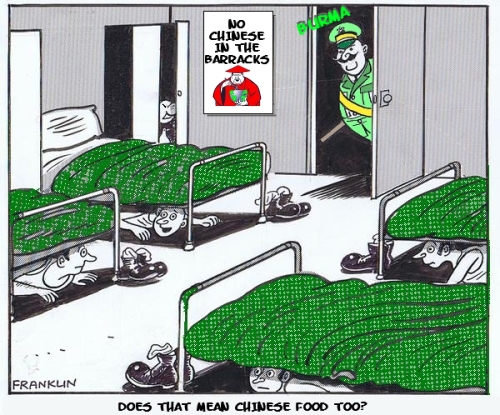 Where
does that leave us in the U.S. Army? Considering that even
with the political changes afoot in Burma the Burmese
military will run the country for decades to come (think:
Turkey), the only way to broaden ties between the U.S. and
Burma will be via military to military contacts… in other
words by having the U.S. Army take the lead in building
closer ties with the Burmese Army.
Where
does that leave us in the U.S. Army? Considering that even
with the political changes afoot in Burma the Burmese
military will run the country for decades to come (think:
Turkey), the only way to broaden ties between the U.S. and
Burma will be via military to military contacts… in other
words by having the U.S. Army take the lead in building
closer ties with the Burmese Army.
Why? Because military people are alike no matter what
uniform they wear: we think the same, we talk the same
language, and we view the world through the same
conservative but jaundiced glasses. Because of this the U.S.
Army will be able to do things to influence Burma’s behind
the scenes military rulers that the State Department
attachés would never be able to do. Like get them to toss
their friend China out of the barracks in favor of the new
guy on the scene: America.
Strategically, it is an American imperative that the U.S.
loosen the linkage between Burma and China. In our view only
the U.S. Army can do that.
As important, much of that strategic imperative comes from
military needs, and who better to deal with strategic
imperatives born out of military matters than the military
people who will have to fight to overturn those matters if
the cause that created them is not peacefully undone. A few
examples will suffice.
 For
one, unless the U.S. military is able to gain a peaceful,
respectful, mutually beneficial foothold in Burma—alongside
of and sharing beers at night with our new friends in the
Burmese Army—it may one day find itself facing China’s
military sunning itself on the Indian Ocean. The reason is
that China’s current strategically cooperative relationship
with Burma gives it land access to the Bay of Bengal and the
Indian Ocean. So, since the U.S. military will be the ones
called to block China’s advance via this route during a time
of conflict, who better to figure out how to undo this
“opportunity” for China now than the U.S. military? Since we
are being sent over to Burma today to begin building better
relations between our two militaries, shouldn’t we get busy
figuring out how to get the Burmese to peacefully deny this
route to China rather than wait until we have to stop the
Chinese Army with the 1st ID?
For
one, unless the U.S. military is able to gain a peaceful,
respectful, mutually beneficial foothold in Burma—alongside
of and sharing beers at night with our new friends in the
Burmese Army—it may one day find itself facing China’s
military sunning itself on the Indian Ocean. The reason is
that China’s current strategically cooperative relationship
with Burma gives it land access to the Bay of Bengal and the
Indian Ocean. So, since the U.S. military will be the ones
called to block China’s advance via this route during a time
of conflict, who better to figure out how to undo this
“opportunity” for China now than the U.S. military? Since we
are being sent over to Burma today to begin building better
relations between our two militaries, shouldn’t we get busy
figuring out how to get the Burmese to peacefully deny this
route to China rather than wait until we have to stop the
Chinese Army with the 1st ID?
For another, one of China’s main goals in getting closer to
the Burmese military rulers is to enable construction of a
well thought out overland oil pipelines grid that will take
oil from the Burmese coast to South China. More than a means
to bring more oil to China’s sweatshops, this is a coveted
goal of the Chinese military, designed to outflank and avoid
dependence on the Straits of Malacca for oil supplies. Why?
Because the U.S. Navy can easily block the Straits and deny
critical oil to China’s military in a time of conflict.
Again, if the case has to be made between using U.S.
diplomats to persuade Burma’s military leaders to put a stop
to this project, or U.S. military personnel who are resident
in the country as part of a long term exchange program, then
this author would vote for the military. Why? Because
military people speak the same language, and it is easier
for a Burmese General to ask a U.S. Army General for new
toys to play with if he is to grant the U.S. General’s wish,
than a State Department official that a) does not know what
the new toy’s kinetic strength is, b) will have to go to the
Pentagon to get it approved anyway, and c) will (because of
his liberal mindset) fear giving any kind of new weapon
system to the Burmese military.
Summarizing then, it is easy to see that most of the reasons
for needing a containment strategy for China stem from
military matters to begin with. Considering that Burma is
ruled by military leaders, it is only natural that the U.S.
military, with the Army in particular, should carry a better
than fair share of this load. Whether it’s the need to deny
China a land bridge to the Bay of Bengal, stopping an oil
pipeline that benefits few more than China’s army, or
securing military oversight over the offshore oil-blocks
sprinkled throughout this region (think: the ‘energy
strangulation’ of China), all of these factors and more come
into the picture only because of strategic military
necessities. Who better then to manage America's resolution
of these strategic military necessities than America's
military? And, since management will entail working closely
and on a day to day basis with Burma's Army, who better
within the U.S. military than the U.S. Army?
Finally, if reading this causes you to pay attention to
future news items about how China views the U.S.’ intentions
in Burma, pay no attention to the claims China makes that
the U.S. and China have no reason to clash over Burma. The
truth is otherwise. China has invested substantially in this
country over the last three decades and they are not
prepared to lose. They would rather go to war than see the
U.S. Army have a base in Burma.


Have a comment on this article? Send it
to us. If you are a member of the Association we will
gladly publish it.
If you are not, well, it only costs
$30.00 a year to become a member and have your views heard...
and because
we are a fully compliant non-profit organization your payment is tax
deductable.





 -
- - - - - -
-
- - - - - -