Continued from the August 2012 Home Page. To go to an archived version of
that page click here:
August
2012 Home Page Archive. To return to this
month's actual Home Page click on the Signal Corps
orange Home Page menu item in
the upper left corner of this page.

continuing...
 By
the summer of 1943 the most important element of the Signal
Corps’ training program, that portion that pertained to
specialist training activities, took in their highest quota
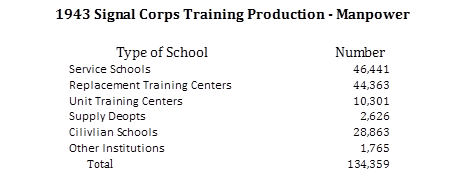
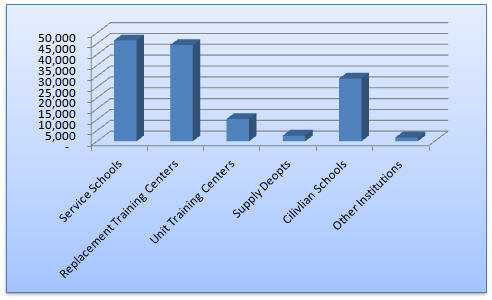
of men: 47,000 men were enrolled in Signal Corps training
schools, plus another 10,000 Army Air Forces (AAF) students,
with an additional 10,000 from other arms and services such
as the medical corps, engineers, tank corps, infantry, and
more. That was on June 30, 1943. By the end of July all-time
peak enrollment in the Officer school programs
By
the summer of 1943 the most important element of the Signal
Corps’ training program, that portion that pertained to
specialist training activities, took in their highest quota
of men: 47,000 men were enrolled in Signal Corps training
schools, plus another 10,000 Army Air Forces (AAF) students,
with an additional 10,000 from other arms and services such
as the medical corps, engineers, tank corps, infantry, and
more. That was on June 30, 1943. By the end of July all-time
peak enrollment in the Officer school programs
 also
reached their high, with 2,817 officers studying advanced
communication subjects.
also
reached their high, with 2,817 officers studying advanced
communication subjects.
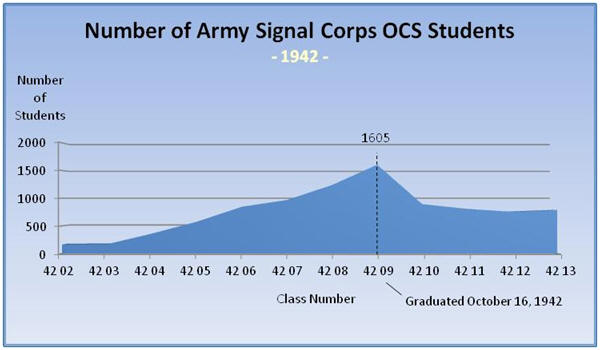
As for Army Signal OCS itself, by
the middle of 1943 its enrollment was already in decline.
The peak had been reached in October 1942 when the school
graduated 1,605 Second Lieutenants in OCS Class 42-09.
Noting that the Army’s fiscal year ends on June 30, for the
fiscal year 1943 (which includes the last 6 months of 1942)
Signal Corps courses across the board graduated 134,359 EM
as well as 16,087 Officers that completed specialized
training, plus another 10,270 Signal OCS graduates.
Those of you who are regular
readers know that we have often written of soldiers from other service arms
that went through Signal
 Corps
OCS and other training. Between 1942 and 1944 the number of students who
cross trained in other service arms totaled about 75,000. Of these 14,000
completed Signal Corps replacement training, making them eligible to fill
Signal Corps slots that had become open. An additional 2,100 officers and
33,000 enlisted men from other services completed courses in Signal Corps
schools and then returned to their own branch. And to round it all off,
about 1,050 officers and 25,000 enlisted men studied in civilian schools
teaching Signal Corps courses… sometimes because there were not enough slots
in the regular Signal Corps schools on base to accommodate them, and
sometimes because the subject matter was so advanced that the Signal Corps
did not have a training program to cover it.
Corps
OCS and other training. Between 1942 and 1944 the number of students who
cross trained in other service arms totaled about 75,000. Of these 14,000
completed Signal Corps replacement training, making them eligible to fill
Signal Corps slots that had become open. An additional 2,100 officers and
33,000 enlisted men from other services completed courses in Signal Corps
schools and then returned to their own branch. And to round it all off,
about 1,050 officers and 25,000 enlisted men studied in civilian schools
teaching Signal Corps courses… sometimes because there were not enough slots
in the regular Signal Corps schools on base to accommodate them, and
sometimes because the subject matter was so advanced that the Signal Corps
did not have a training program to cover it.
All of this leads us to what started this article in the
first place: listing the numerous Signal Corps camps and forts that were
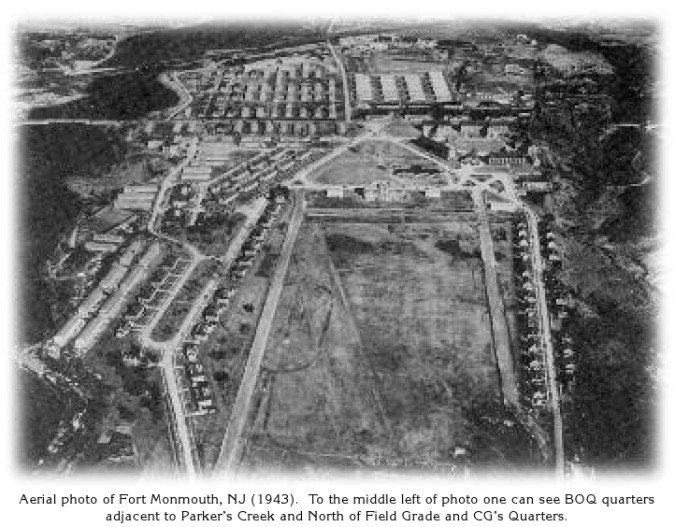
needed to support this massive training program. By mid-1943 replacement
training centers and specialist schools were operating at Fort Monmouth, New
Jersey; Camp Crowder, Missouri; and Camp Kohler, California. Among these
Camp Crowder provided unit training rather than individual training. Further
away, radar training was concentrated at what became known as the Southern
Signal Corps School, at Camp Murphy, Florida. Photographic training on the
other hand was handled at the Signal Corps Photographic Center at Long
Island City, New York.
Technical training was not the only thing the Signal
Corps needed to accomplish in order to meet its mission. All of the
materials and supplies that kept the Signal Corps operating had to be
acquired, packaged, shipped, tracked, inventoried, and maintained…
everywhere on earth from the cold of Alaska and Russia to the jungles of
Luzon and Borneo. Because of this the Signal Corps found itself in the depot
supply business, setting up training programs to match. These supply courses
led to one of the largest inventory and material management systems operated
by one organization, anywhere on earth. While perhaps not the intention, the
fact was that the Signal Corps developed the first working model of JIT
(Just In Time) inventory management, a concept that is classified today as a
world class form of materials management.
But that wasn’t the end, while training radio carriers
to run alongside of the Infantry, and developing a new supplies management
process took a priority, training Signal Corps
Officers in advanced subjects dealing with leading edge technologies was
also an imperative. This latter need drove the Signal Corps to send dozens
of Signal Officers to advanced radar courses at Harvard University and MIT
(the Massachusetts Institute of Technology). Cryptographic training was
provided to Signal Officers at Arlington Hall and Vint Hill Farms Station in
Virginia. Still other courses too numerous to list were held in dozens of
vocational schools, schools run by corporations, and colleges spread
throughout the U. S. Finally, dozens of Signal Corps Officers went through
training in the British military school system too, to be sure that joint
operational coordination between the U.S. and England went smoothly from a
combined communication standpoint.
Among the logistic and planning nightmares that
challenged those who wrote the Signal Corps’ training syllabus was the never
ending need to constantly alter course material to reflect content that
matched the constantly changing onslaught of new communication devices,
tactical doctrines, and the lessons streaming in from the field… lessons
learned firsthand via the Signal Corps’ increasing combat experience. Over
time these lessons caused a shift in the pedagogy of Signal Corps training,
moving it away from an emphasis on individual instruction towards training
centered around teamwork. Not surprisingly this took place for both enlisted
men and Officer training. If one thinks about it, this shift marked the
first time the U.S. military began to focus on the overwhelming advantage
combined arms operations provided during combat. And as every good Signal
Officer knows, teamwork provides the corner stone of effective combined arms
operations.
 As 1943 dragged on and preparations were made for the
invasion of Italy and Normandy, and MacArthur’s island hopping campaign
began to pick up speed the requirements coming back from the field began to
change. Up until this point most division Signal Companies were staffed by
Signal Officers. By the late summer of 1943 these Signal Officers, who
earlier had been in high demand, were now a dime a dozen. At the same time
the Army Ground Forces (AGF) found itself generally over-strength in terms
of Officers, with the result that they began to assign their own Officers to
division level staff positions that used to be filled by Signal Corps
Officers.
As 1943 dragged on and preparations were made for the
invasion of Italy and Normandy, and MacArthur’s island hopping campaign
began to pick up speed the requirements coming back from the field began to
change. Up until this point most division Signal Companies were staffed by
Signal Officers. By the late summer of 1943 these Signal Officers, who
earlier had been in high demand, were now a dime a dozen. At the same time
the Army Ground Forces (AGF) found itself generally over-strength in terms
of Officers, with the result that they began to assign their own Officers to
division level staff positions that used to be filled by Signal Corps
Officers.
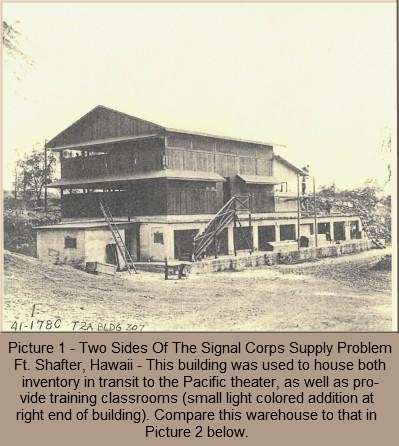
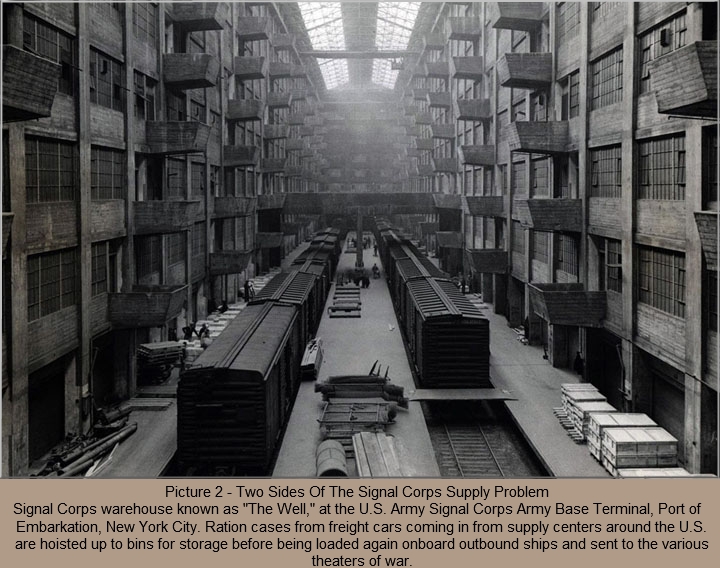
Not surprisingly, while surplus
Officers began to appear in these areas, in other areas Officer shortages
materialized. One of them was in the area of supply assignments. Here
Officers were badly needed to manage the mounting production line problems
that accompanied the rapidly filling warehouses and depots being built
around the world. The problem for supply management was simple: there
weren’t enough properly trained supply staff to handle the escalating stock
control and inventory management issues that a country fighting in every
corner of the world needed managed. Not surprisingly, by that time the
Signal Corps had the best training infrastructure of all of the services,
one that could easily adapt itself to the training of almost any
support service needed. Because of this it was asked to get into the
business of training supply staff. Immediately a supply course was set up at
Ft. Monmouth and scheduled to begin training students on 1 July 1943.
However, war is war and while the planning and student assignments for this
training course proceeded, the demands of war came first. In this case it
resulted in the students scheduled for that course being hurried off to
Europe without any training, rather than to Ft. Monmouth. When they
hit the ground in Europe they were immediately assigned to the Signal Corps
and reposted to fill the urgent
supply needs that existed there. As a result the 1 July supply training
program got underway a month later… with the same class designation, but a
different roster of recruits.[1]
Other problems like this popped up along the way.
Problems like determining where and how Army Air Forces training would be
integrated with general Signal Corps training. Clearly, aviators needed
training that was different than signalmen. But then again, the signalmen
running the Signal Corps were responsible for assuring that the training the
AAF received met the mission’s needs. In the end, if the AAF failed in its
mission, being a part of the Signal Corps it was the Signal Corps’ brass
that was going to get the blame. As a result AAF and Signal Corps Officers
drew together and collaborated to assure that the training programs the AAF
mounted used what we would call today best of breed practices…
techniques born of the results of the Signal Corps’ own training programs.
The success of this approach was proven out when the new Aircraft Warning
Service (AWS) was launched. Operationally, the AWS integrated AAF flight
programs with Signal Corps communication networks to provide advanced
warning of attack. To assure that both sides knew what they were doing, and
that the result of this ”combined arms operation” was the achievement of the goal of
delivering early warning of attack, the Signal Corps trained AAF men and the
AAF trained Signal Corps men. Not surprisingly, it worked.[2]
All in all, what 1943 taught the Signal Corps was that
more than anything it had to accept the fact that the war then underway was
dynamic and constantly changing. From a training standpoint this meant that
the Signal Corps needed to build a training infrastructure that allowed for
quick changes to what otherwise had to be stable school programs that were
intensive in instruction and broad in scale. Without a training template of
this type it would
not be possible to provide the massive number of Signal Corps men needed for
duty throughout the U.S. military. In the end, that was the goal: ready as
many men as possible for shipment overseas as quickly as possible.
As
1943 drew to a close, the seriousness of this mission came home to roost: The
planning for the invasion of Sicily, Italy and Normandy soon began to
drain Signal Corps people from all over the world towards the English
countryside. The Alaskan Department and the Northwest Service Command soon
became no more than a military backwater. Across the vast Pacific orders
went out sending every available Signal Corps man and then some to Europe.
And at every Signal School from Ft. Monmouth to Pinedale, California,
teachers and students buckled down to the task of preparing signaleers for
combat.
The remarkable thing is
that they did it better than it had ever been done before. Even until today,
nowhere will you find a university or other advanced education institution
that graduates over 160,000 students a year, as the United States Army
Signal Corps did in 1943.


Footnotes
[1] Facts stated sourced from:
R&W Action: 1,
Major James
A. Wadsworth, Signal Supply Service to Military Training
Brigade, 24 Jun 1943, subject: Training Signal Supply Officers
for Overseas Assignment. (2) Lieutenant Colonel Louis Cansler, Acting Director
Signal Troops Division, Officers' Advanced Program, both in Signal
Corps publication 353, Ft. Monmouth 2 (RTC), Jun-Jul 1943.
- To return to your place in
the text click here:

[2] The Signal Corps School at Camp Murphy devoted itself to
individual training of radarmen for the AAF. The AAF's three signal aviation
unit training centers at Drew Field, Tampa, Florida, Pinedale, California,
and Langley Field, Virginia, were established in co-operation with the
Signal Corps to prepare Signal Corps units for field service with the AAF.
- To return to your place in
the text click here:
Additional Sources Used In The Writing Of This Article
George Raynor Thompson and Dixie R. Harris,
The United States Army in WWII, the Technical Services, Center
of Military History, Washington, D.C., 1991.
For a general discussion of training of
non-divisional units 1942-45, see Robert R. Palmer, Bell I. Wiley, and
William R. Keast, The Procurement and Training of Ground Combat Troops,
United States Army in World War II (Washington, 1948), pp. 499-560.
- - - - -
Have a comment on this article? Send it
to us. If you are a member of the Association we will
gladly publish it.
If you are not, well, it only costs
$30.00 a year to become a member and have your views heard...
and because
we are a fully compliant non-profit organization your payment is tax
deductable.





 -
- - - - - -
-
- - - - - -