Continued from the February 2013 Home Page. To go to an archived version of
that page, click here:
February 2013 Home Page Archive. To return to this
month's actual Home Page, click on the Signal Corps orange
Home Page menu item in
the upper left corner of this page.

continuing...
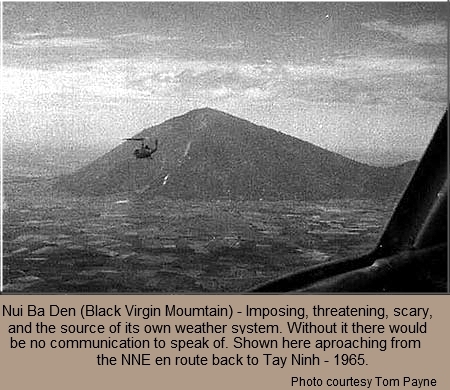 An
example of this can be seen at Nui Ba Den, one of the few
mountains of useful height in the 1st ID’s tactical area of
operation. It proved critical to maintaining a number of the
long multi-channel “shots” to the rapidly shifting forward
command post locations that filled the surrounding flat
land. But it wasn’t enough. After all, it was only one
mountain, where 20 were needed.
An
example of this can be seen at Nui Ba Den, one of the few
mountains of useful height in the 1st ID’s tactical area of
operation. It proved critical to maintaining a number of the
long multi-channel “shots” to the rapidly shifting forward
command post locations that filled the surrounding flat
land. But it wasn’t enough. After all, it was only one
mountain, where 20 were needed.
The answer of course was to erect signal towers. The only
problem was that back then the TOE for a Signal Battalion
didn’t include equipment for signal towers. Strangely, while
no such equipment existed or was authorized, signal towers
soon began to appear. Since few people knew that they
weren’t authorized or part of a Signal Battalion’s equipment
list, few people asked questions. For the most part
Captains, Majors, Colonels and the higher ranks that saw
them simply assumed that they were supposed to be where they
were, or they wouldn’t be there. No one asked how they got
there, who authorized them, or anything. And from the rank
of Lieutenant on down, no one told. When a tower was needed,
it just magically appeared. Another example of American
ingenuity at its best.
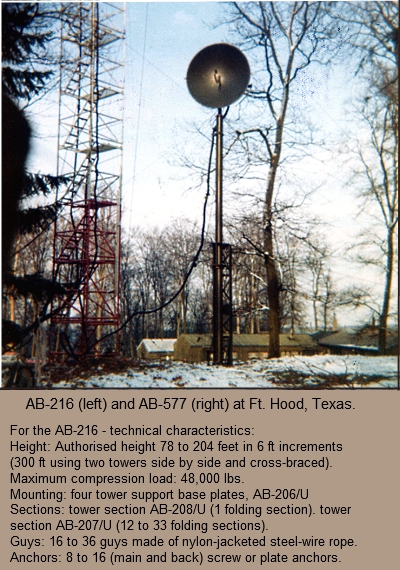
As to what they looked like, they were usually cobbled
together from the two standard issue systems that made up
the 45 foot AB-577 and the 65-foot AB-216. With a little
judicious use of guy wires these things could be erected up
to and over two hundred feet into the air.
 How did the troops involved know this? Part of the answer
can be traced back to Army Signal OCS, at Fort Gordon, where
early 1966 Officer Candidates were shown how to erect
towers, guy them, and keep them up in the wind. Because of
this fortuitous training, when these same butter bars hit
the field in Vietnam and their EMs told them that the way to
solve the connection problem was to get the antennas up
higher than the surrounding terrain, they instantly thought
of the towers they had trained on back at OCS. The fact that
this solution involved equipment that was not authorized to
their units, or readily available, didn’t matter. What
mattered was getting the message through… and they knew that
could be done by simply putting an (unauthorized) tower
higher than anyone had before. Wet behind the ears as Second
Lieutenants they may have been, but intimidated they were
not. After all, they had themselves built these same towers
back on the fields of Signal OCS and so knew that the
equipment was strong, reliable, and not beyond their ability
to master.
How did the troops involved know this? Part of the answer
can be traced back to Army Signal OCS, at Fort Gordon, where
early 1966 Officer Candidates were shown how to erect
towers, guy them, and keep them up in the wind. Because of
this fortuitous training, when these same butter bars hit
the field in Vietnam and their EMs told them that the way to
solve the connection problem was to get the antennas up
higher than the surrounding terrain, they instantly thought
of the towers they had trained on back at OCS. The fact that
this solution involved equipment that was not authorized to
their units, or readily available, didn’t matter. What
mattered was getting the message through… and they knew that
could be done by simply putting an (unauthorized) tower
higher than anyone had before. Wet behind the ears as Second
Lieutenants they may have been, but intimidated they were
not. After all, they had themselves built these same towers
back on the fields of Signal OCS and so knew that the
equipment was strong, reliable, and not beyond their ability
to master.
And so it happened, Enlisted ingenuity and the excitement of
Junior Officer command led to signal towers popping up all
over the place in the II Corps zone, authorized or not. Find
a field command post or forward fire base in Central Vietnam
and the chances are you would also find a couple hundred
feet of tower sticking up into the sky.
Whatever the cause, whatever the reason, it worked. These
off-the-cuff towers kept the VHF and UHF systems on air,
providing to every major combat unit the voice of command
they needed.[1]
As to what all of this accomplished, it set the tempo and
tenor for how tactical Signaleers would face the war ahead.
By combining rapidly constructed towers of the kind first
learned about back on the training fields of Signal OCS with
ground and light air-transportable equipment layouts, wooden
boxed pieces of signal equipment kluged from much larger
systems, air borne relay stations, and upgraded VHF and UHF
equipment, field signal platoons were able to install,
operate and maintain backbone field expedient multi-channel
trunking and switching systems able to meet the needs of any
tactical combat field unit… of any size… any complexity… at
any number of forward bases… in support of any combat team
with a fire in their belly to find and fix the enemy, and
jump to the occasion by moving itself at the trigger of a
trip wire from where it was to some other God forsaken
location in Vietnam… and then get up and do it all over
again the next morning.
Yet while all in all the system worked and worked well, it
wasn’t perfect. As the combat units settled into their
routines the pace quickened even more, bringing the rate of
combat engagement up several notches higher than that which
had been set when they first arrived in country.
The case of the 1st ID gives an example. For it the links
the commo guys set up between the main command post at Dĩ An
and the brigade main command post at Phuoc Vinh worked well,
but still only provided basic communication. So too for
communication between the brigade command post and the
division's forward command post at Lai Khe, and similarly
for division support command, which was tied into brigade
headquarters at Dĩ An. All in all, basic communication… with
a jump capability thrown in to tie together the division and
brigade tactical command posts whenever they were deployed.
But beyond that, the system simply could not keep up with
the evolving needs of the combateers, especially as their
commanders grew to spend more and more time in the air. In a
nut shell, the combat commander’s growing penchant to spend
as much time in the air as they could, applying and employing
helicopter borne command and control rather than pacing back
and forth in an office back in the rear, put a stress on
field communications that the Signal Corps had not seen in
all the wars before.[2]
How did the Signal Corps fix this problem? You’ll have to
drop back next month to find out that answer. Next month
we’ll take a look at the communication problem helicopter
borne command and control created, and how the Signal Corps
went about solving it. Join us then to continue the story of
the Signal Corps’ efforts in the 1965 – 1967 period, when
the war began in earnest.


Footnotes
[1] At Dĩ An base camp the tower stood at 120 feet. At
Christmas the Signaleers traded around until they had enough Christmas
lights to wrap the guy wires. To make sure the symbolism wasn’t missed, they
topped it with a huge star. One written archive of the time stated that when
“the Big Red One communicators gathered about the tower, the commanding
general of the division commended them for their outstanding work as
communicators and, at the conclusion of his remarks, officially lit the
‘tree’.” Little did he know that the tower was not part of the TOE, was
unauthorized and built from scrounged parts and materials. As the ceremony
proceeded, starting with a few 1st Lieutenants and on down through the
enlisted ranks, smiles and chuckles spread throughout the assembly as the
idea gained momentum that they were being commended for what was essentially
an unauthorized activity and something that flaunted SOP. For most of the
higher Officer ranks however, at least for those that noticed the levity and
jostling of the crowd, the question was bantered about as to what the troops
found so humorous that they could hardly contain themselves.
- To return to your place in the text click here:

[2] Dĩ An is a town in Binh Duong province in
southeastern Vietnam, about 20 km north of Saigon (now Ho Chi Minh City). It
is 1706 km by rail from Hanoi. As of the 2009 census the town had a
population of 73,859. The town covers 60 km².
- To return to your place in the text click here:
Sources
Primary source material, data and statistics used in this
article taken from Vietnam Studies, Division Level Communication, 1962 -
1973, Lieutenant General Charles R. Myer.
Comment Section
Have a thought on this article? Let us know what it is.
Use your real name or pick a User Name. eMail addresses are optional. If you
provide one we will add you to our Scholarship Program mailing list and keep
you informed of upcoming events.
Like this article? Let us know by
helping us with our scholarship fund efforts. A $30.00 donation
to our
Scholarship Fund
will help us get one step closer to helping another deserving High School
graduate attend college. Your donation is tax deductible and your
kindness will go father than you think in making
it possible for another young American to fulfill their dream of a college
education. Thank You!