Play our music game. See if you can find the hidden
Army marches on our site. Click the icons you find on each page. Some have music
hidden
behind them, others do not. Good luck!
Music courtesy USAREUR Band
To follow us on Twitter, click here!
Click below to LIKE us!
Click below to check out our Facebook page.
Make a difference!
It’s easy to give!
As a non-profit organization donations to our Scholarship Fund are 100%
tax-deductible.
More importantly, your donation helps students of Signal OCS families achieve
their dream of a college education.
Contributions in any amount are welcome.
Just click on the
DONATE
button above to make a donation right now.
Thank You!
From
Home Page Archive:
Home Page as originally published in February 2013
MISSION STATEMENT
Our Association is a
not-for-profit fraternal organization. It's purpose is a) to foster
camaraderie among the graduates of Signal Corps Officer Candidate
School classes of the World War II, Korean War, and Vietnam War
eras, b) to organize and offer scholarships and other assistance for
the families of Officer and Enlisted OCS cadre who are in need, and
c) to archive for posterity the stories and history of all of the
Signal Corps OCS Officers who served this great country. We are open
to ALL former Army Signal Corps OCS graduates,
their families and
friends, as well as other officers, enlisted men, those interested
in military history, and the general public. Please, come join us. For more information about our
Association, to see a list of our Officers and Directors, or for
contact details, click on the OCS Association link at left.
Please note: The
views and opinions expressed on this website are offered in order to
stimulate interest in those who visit it. They are solely the views
and expressions of the authors and/or contributors to this website
and do not necessarily represent the views of the Army Signal Corps
Officer Candidate School Association, its Officers, Directors,
members, volunteers, staff, or any other party associated with
the Association. If you have any suggestions for improvements to this site,
please send them
to WebMaster@ArmySignalOCS.com. We
are here to serve you.
Turn Back The Years
The following article is reprinted
from the July 21, 1944 edition of the Fort Monmouth Message
newspaper. It's bound to give you nostalgia, even if
you are not
a WW2 vet.
Contributed By Don Mehl, Class 44-35
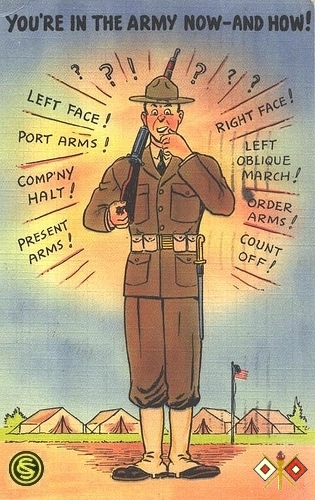
So... You Yearn to
Tackle OCS?
Read This... You May
Weaken!
By Cpl W. Paul Thread
(Bloody but unbowed OCS editor
for a day)
So!...you’re thinking about going
to OCS.
You just know that you would make a swell lieutenant. You’re
sure that that officer’s uniform would look just dandy
draping your figure. You visualize all the attention you’d
get as you walk down the street of your home town. And of
course you’re thinking of the wonderful reception you’re
going to get when the favorite girlfriend gets a “gander” at
the resplendent uniform with the gleaming gold bars. And
didn’t you get over 110 on the AGCT. Why it’s a snap…you
think!
With the increased quota for the Officer Candidate School
and the subsequent interest shown by the men of this Post
the MESSAGE editor thought it would be a swell idea (he
would!) if one of his hapless and helpless minions would
spend a day as a student at OCS. Selection of the reporter
was calm but firm. A pointed finger and the word “you”!)
At 0545, as the grey mists of the morning to come gently
swirled about the sleepy head of your reporter, he arrived
at the area to begin his day as an Officer
Candidate. Complete wakefulness came soon enough. The OC’s
day begins with all the fury of an artillery barrage. Caught
between rushing candidates, barked commands and snappy
salutes’ your reporter felt like a featherless pigeon caught
in a hurricane.
A Gig For A Gig
From the moment that candidate opens his eyes the “Mister”
is fair game for a ‘gig from one of the eagle eyed tactical
officers. However, in OCS a “gig” is not a “gig”; it’s a
delinquency and to even call a delinquency a “gig” is only
to be “gigged” again. Confusing…isn’t it?
Breakfast is downed with gusto and policing the bunk area is
dispatched with neatness and speed. Trained to adapt oneself
to any situation the art of coordination is stressed to the
candidate. And that he has learned to coordinate and is
coordinated was very obvious to this reporter who watched
the candidates perform their duties and tasks rapidly and
with apparently effortless ease. Your correspondent in
attempting to keep up with them and emulate the candidates
got lost in the shuffle.
Class periods sometimes run to two hours. It’s a serious
business this learning all the intricacies of being a Signal
Officer and rapt attention to the instructor is the rule.
Instructors deal with their subjects in straightforward
fashion to and to the point, but always allow their
students to voice a blunt counter opinion.
The cross country runs and the difficult obstacle courses
would do full justice to the physical ability of a seasoned
mountain climber. Even your scribe who has had some of this
experience in the rugged terrain of Alaska did his share
puffing and grunting as he labored over the trails and mazes
and finally made it successfully. Some few of the more
obese future officers did not. But if you are no muscle man,
the ubiquitous and omnipotent tactical officer may well
appreciate a display of plain "guts’’ with no attempted
short-cuts.
IDR For Superman
If you are contemplating exchanging your stripes (if you
have any) for the orange arm band of the Officer Candidate
you had better start clearing your throat and cultivate your
commanding presence. Graded drill is your chance to take
over the unit and put them through the paces of close order
drill. If you are prepping it would behoove you to
substitute the IDR for Superman comics as reading
matter. And as another suggestion for a would-be Officer
Candidate, try to persuade your top-kick to let you take the
outfit over for that W. K. practical experience.
Button, button, button your buttons or your name will adorn
that ominous sheet of paper with the rest of the
delinquents. If you are the type that once dashed down Main
Street with your camel hair coat fanning in the breeze you
may sometimes think that the entire United States Army is
concentrating its efforts on the proper employment and
placement of the lowly button.
Another simply ducky way to get your name posted is to have
your arm band slightly askew, move in ranks, strike a stoopy
stance, give a sloppy salute, have a bit of dust on an
otherwise shining shoe and so on ad infinitum. Three
delinquencies in one day and it is your high privilege to
meet face-to-face with the senior tactical officer. A total
of ten and the conversation is likely to become downright
personal.
Steady Pressure
It’s a serious business though, this OCS; and the man who
makes it really deserves the appellation. Men put in about
15 hours a day doing their role of Officer Candidate. There
is the highly accelerated march, the frequent double time,
and the pass is something you remember from those dim days
as a non-com or private. Pressure is continuous and the man
who can take it in his stride and in perfectly coordinated
manner is the man who gets the brass bars. Many fall by the
wayside but many make the grade. Think you can do it?
1966 –The War Begins In
Earnest
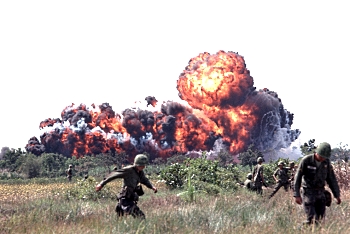
1966 Napalm Drop - "Smoking
Charlie From The Tree-line"
A Vietnam
Retrospective - The Signal
Corps
In Action
The war in Vietnam did not
get up to speed as rapidly as some might think…
combat wise things got off to a slow start. Up
until 1965 combat operations just sort of bumped
along. But around about the end of 1965 it all
began to change, as more and more units began
arriving in country, with their commanders
anxious to get it on.
To be more specific, America's
military involvement in Vietnam began with advisors sent to
assist Ngo Ding Diem’s rookie army in 1954. Between 1961 and
1964 their number grew from 900 to 23,000. Yet while the
number was significant, the involvement of these advisors
was minimal, being relegated to a narrowly defined
instructional and training role. It wasn’t until February
1965 that the U.S.' first independent combat operation was
mounted in what would become known as the Vietnam War, and
that involvement centered around a series of retaliatory
strikes after the Gulf of Tonkin incident.
Being what it was, no ground troops
were involved, as the strikes were carried out by the U.S.
Air Force and Navy. Strange as it was however, neither this
independent action on the part of the U.S. to escalate the
war, nor a decision made in February of 1965 to increase the number of
ground troops in-country by sending 3,500 Marines to Đà Nẵng, was shared with the South
Vietnamese government. Except for a trifling last minute
request to the South Vietnamese Premier Dr. Quat the morning
of the Marine's actual arrival on the beach—to issue a press statement supporting the
U.S.’ efforts—the South Vietnamese were kept in the dark
until it was too late for them to do anything about it.
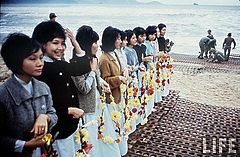
Instead, miraculously, the Marine's amphibious assault craft
simply appeared on the horizon, world press just as
miraculously appeared on the beach, as did dozens of pretty
young Vietnamese girls dressed in áo dàis,
ready to drape the advancing Marines with leis. Does anyone
sense an ego at work here?.[1]
That
was the case for the 3,500 Marines
that landed at Đà Nẵng on March 8, 1965... and it was also
the case for the 20,000 support
personnel that were ordered to Vietnam on April 1, 1965, as
well as
the order issued on April 14 to deploy the entire 173rd Airborne
Brigade. For a war that was supposed to be about Uncle Sam
working hand in hand with the South Vietnamese government to gain control of the country,
upgrade the skills of the ARVN, help the ARVN oust the NVA and V.C.,
and set up a democratic system of government,
Westmoreland sure was keeping his "partner" in the dark
about his intentions.
One wonders, if the government and
military of
South Vietnam... even in those early days... had a greater involvement in planning and
prosecuting the war, or at least understanding the logic
behind America's actions, might they not have been able to
go it alone when the time came? And if not... that is, if it
was not possible for the South Vietnamese ever to go it
alone... then what were we doing there in the first place?
Was the plan to stay forever? No? Then why wasn't the South
Vietnamese government and its military brought into the
equation day one and taught what they needed to know to run
their own country... including the knowledge that we
weren't going to stay forever and that they had better
get on about building both a democratic country and a
military that could defend it, instead of wasting their time
fighting internecine political wars for power while we
pursued Charlie in the boonies?
To this author it's amazing the
stupidity with which America fights its modern day wars to
free nations. Yes, it's o.k. to send our men into battle to
help free the people of another country... but if we are
going to do so then we should demand that the leaders of
that country step up to the task of creating both a
functioning government and a capable military. If the
leaders they pick don't prove up to the task, then we should
pluck them from power and tell the people of the country to
pick another one... and keep doing this until some local
George Washington steps forward and shows that he
understands his role is to be that country's George
Washington, not its Napolean.
Regardless, as the summer of 1966
approached things really began to “hot up.” By
August five new major combat units had arrived
in country, and with their arrival serious
combat operations got underway. Technically,
1966 represented the second year of serious
combat for the U.S. Army, but in reality it was
the first year when the Army had enough men and
materials to mount a vigorous, forceful,
coordinated effort. So in 1966 the war began in
earnest, and with it the Signal Corps was put to
the test.
Since most of the training
of the newly arrived Signal units had occurred
in Europe or the U.S., where methods of
communication between combat units had already
been codified into a science for some 20+ years,
it came as a surprise to those setting up the
systems in 'Nam that these same approaches to
the use and application of communication
technology were not operating as expected.
Instead, rather than finding that their deployed
gear worked swimmingly, what they found was that
things that had worked back home simply didn’t
work in Vietnam.
One of the reasons, as
they quickly learned, was that while the terrain
back home and in Europe was benign and conducive
to the kind of communication architectures and
equipment the Army employed at that time,
Vietnam was proving to be different. More to the
point, what they found was that whether because
of the unique tactical scenario the enemy
presented in Vietnam, or the climatic and
geographic conditions that existed, getting
reliable communication up and running was not
only proving difficult but often times
impossible. Overall, getting communication links
in place to support tactical combat field
operations was turning out to be a real problem
for the Signal Corps in the early days of 1966.
To make matters worse,
while many units, like the 25th Infantry
Division, had trained for jungle operations in
climates similar to that of Vietnam, and had
learned something or two in the process, the
combat similarities they internalized didn’t
carry over to the Signal support personnel that
trained with them. That is, while for the
infantry boys combat simulation in a hot climate
proved to be similar to what they found in
Vietnam, this same training regimen was proving
to be of little value to the Signaleers arriving
in Vietnam. The reason was that what the combat
boys were up against was heat, while the Signal
guys were up against something entirely
different: a topographic environment far
different than either what they had trained in
or that which their equipment was designed for.
It’s one thing to learn to take a few salt
tablets and keep yourself hydrated, it’s another
to learn how to bounce a ridge line signal over
a bunch of hills and then aspirate it through a
jungle canopy until it hit the FM radios on the
other side.
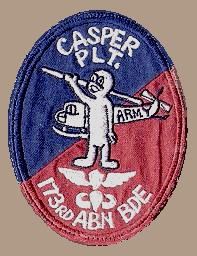
This
became evident when the first major combat
element to arrive in Vietnam, the 173rd Airborne
Brigade, discovered that it was having a devil
of a time communicating over extended distances
of any kind. In this case both local terrain
conditions and unit dispersal proved to be the
problem, for while the 173rd's troops were in
Vietnam their logistics base was in Okinawa. All
told, communication between the units HQ, their
logistics base in Okinawa, and their forward
bases in the field proved to be a bridge too far
for the signals equipment being relied on.
For
these guys, where normally voice communication
would be established around the use of the
standard single sideband radio equipment the
unit normally employed, in this new theater of
war this SOP approach was simply not working.
Paramount in this was the fact that the
distances involved were far beyond the designed
range for the assigned equipment, and even when
they weren’t the topographies involved defeated
the system’s ability to carry the signal over
the route needed. From day one then, the
Signaleers found they had to scramble to figure
out how to get voice communication up and
running.[2]
Part of the answer was
found in an expedient solution invented early in
1965, when some Signal guy somewhere mounted an
FM command and control console in a UH-1D
helicopter and took to the skies with it. This
improvised platform was then used as an airborne
relay to help get the message up and over the
obstacles involved, and the distances too, until
it reached the intended party. It proved to be
so effective that almost immediately the idea
was copied by other units throughout the
country.
At the same time the
Signal Corps itself began designing a
communication system to fit in the Huey, so that
combat commanders like those just arriving could
take to the air and control their air assaults
in real time, rather than sit back in an office
somewhere in Nha Trang and try to second guess
the troops on the ground.
This page last updated
1 February 2013. New content is constantly being added.
Please check back frequently.
Posted 1
February 2013
–
A new movie about the early days of the Korean War is
available for viewing in our Video Archives. Called The
Summer Storm of 1950, it includes video footage shot by the
Army Signal Corps. Running only 28 minutes in length, it is
well worth watching. To get to our Video Archive, click on
the link in the column at left. Enjoy!
Posted
6 January 2013
–Know about the 1st Signal
Brigade? Did you know they are organizing a trip to Vietnam and Korea?
In September? Well, now you do, and there's room for you! Click on our
"Reunion Info" link in the upper left column, scroll down the page and
then
read more.
Got an association of your own? Formal? Or just a bunch of old
Army buddies? It doesn't matter to us. Send us your planned get together
schedule, meetings, outings, reunions, or whatever, and we'll post them
on our Reunion Info page too.
Got pictures of you and your buds getting together? Send them to
us and we'll create an album for them and post them on our Reunion Info
page too!
Now how about that!!
Posted 1 January 2013
–
New picture of Brigadier General George Snead, OCS Class
43-27. Taken in 2000 by Don Mehl (see article above also written by Don, Class 44-35), General Snead was a VMI graduate and
served with Don in the Pentagon, in the 805th.
Continued from left column...
The first of these was
designated the AN/ASC6. It included a basic
console, two FM radios, one VHF radio, one UHF
radio, and one high frequency signal side band
radio. In essence, it tried to duplicate what
the earliest Signaleers had patched together as
an expedient to provide both airborne relay and
airborne command and control.
Historical Signal Corps documents claim that the AN/ASC6 was
brought to the field in 1965... if so, it must have been a
well kept secret as there are no contemporaneous accounts of
its use, while there are dozens of stories of kluged
airborne relay systems being built and launched by
eager, creative and driven E3 - E4 Signaleers. Instead, the
earliest accounts of it begin to pop up in early 1968, by
which time the AN/ASC10 was hitting the field, purportedly
to replace the mysterious and unaccounted for ANA/ASC6. As
for the difference between them, the AN/ASC10 provided an
internal intercom system for the command group onboard the
helicopter.
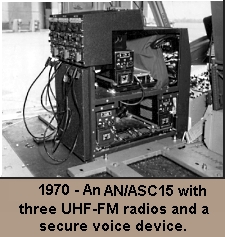
By 1968 every airborne
commander wanted his own command and control
chopper, outfitted with every radio he could get
his hands on. It was as though every LTC and above
had discovered the thrill of Ham radio. And of
course, the Signal Corps obliged, by introducing
the AN/ASC11, followed by the AN/ASC15. About
the time the war started to go flat again (1970–1971
and onward) hardly a commander of any stripe
didn't have his own little 'com center' following him around at all times.
But back in 1966 those days were still a long way off, and
the Signal guys on the ground were struggling to get basic
communications up and running.
While the kludged airborne communication relay was a step in
the right direction, and something that clearly worked, the
concept still depended on bandaged together commo equipment
that was proving to have inherent limitations. For the most
part, the limitations found stemmed from reliance on older,
WWII series FM radio sets… equipment that simply didn’t have
the horsepower needed to deal with the environment Vietnam
presented. Worse, as more and more units arrived in Vietnam
they too ran into the same problems. Within a short while it
became painfully obvious that with or without the airborne
relay concept, a more permanent solution was badly needed,
and its use needed to be turned into a standard operating
procedure quickly.
For
the 173rd Airborne Brigade part of the solution came in late
1965 when the Signal Corps replaced the older series of
radio systems the unit was using with the AN/VRC-12 family,
along with AN/PRC-25 radios. For radiotelegraphy (i.e. high
frequency radio teletypewriter service between the
battalions and brigade) two AN/VSC1 sets were made available
to each battalion, while back at brigade headquarters a
shelter-mounted AN/GRC-46 was provided to interface with
them.
Hot on the heels of the 173rd other
units began to arrive in Vietnam. Among the other units that
arrived during this period was a brigade of the 101st
Airborne Division, a brigade of the 1st Infantry Division,
and another from the 25th Infantry Division. These units too
saw their commo systems upgraded—and none too soon, as major
combat operations began almost the instant the troops from
these units hit the ground. In fact, by late 1966 six major
combat operations involving the soldiers of these brigades
were either underway or had already occurred, with five of
the six happening in the II Corps central threat area.[3]
For
one of these campaigns the 1st Infantry Division (commanded
by Major General William E. DePuy) fielded an operation
called EL PASO II. It began on 2 June 1966, and depended for
its success on the solution to some weighty communication
problems… of both a logistical and operational nature.
From the get-go the 121st Signal Battalion had problems
deploying what was needed to support EL PASO II, as both the
men and the equipment it normally would have used were tied
up supporting the base camp complex at
Dĩ An.
Both men and material were dedicated to this large base
camp, and so it was necessary to find a way to extract the
121st from this duty so that it could focus its signal
duties on providing combat support for the 1st Infantry
Division, which was its normal organic role.
This was accomplished by reassigning the 595th Signal
Support Company to Dĩ An, attaching them to the 69th Signal
Battalion, and giving them responsibility for most of the
121st’s duties. An expedient, looking back now, one can see
that this quick fix was the beginning step in the never
ending game of “unit swap” that saw so many Signal Corps
units assigned, reassigned, and reassigned again throughout
the Vietnam War, until the TOE at the end of the war looked
nothing like it did at the beginning. Whether a mark of
typical American ingenuity or poor planning to begin with,
the flexibility the Signal Corps demonstrated as it moved
its units around the world to support operations in Vietnam,
as though they were pieces on a chess board, was a stroke of
genius. Come hell or high water, people and equipment were
going from where they were to where they were needed, the
TOE be damned.
While the 595th helped free the equipment required for EL
PASO II, it didn't solve the problem of getting the
equipment to where it was needed, and making sure it could
be moved in real time as the troops moved. To solve this
problem the 121st copied what they had seen done by the 25th
Infantry Division. They modified the vans that carried the
VHF multi-channel AN/MRC-69 equipment by removing one stack
of AN/TRC-24 radio equipment and one stack of AN/TCC-7
carrier equipment (one-half the capability of the
AN/MRC-69).
These
were then remounted in a 3/4-ton truck, or more usually
simply boxed in wooden crates that could be stacked together
on arrival at whatever forward base they were headed for,
wired back together, switched on and quickly operated while
the rest of the Signal squad built sand bag barriers around
this unattractive but all important pile of boxes. To make
the whole kludge look and sound like an authorized piece of
real Army equipment, the entire modified ensemble of commo
gear was given the name MRC-34Y2 and deployed. It proved
extremely successful in establishing VHF links in the field,
typically from a forward fire base back to a base camp. Best
of all, because the entire system weighed much less than the
AN/MRC-69 it was replacing, each individual wooden boxed
component could be hand carried by two men, slid inside the
belly of a UH-1, and transported along with the combat teams
as they moved from one forward base to another.
In the case of EL PASO II this proved invaluable as the
division and brigade command elements involved were spread
all over the tactical combat area, with ten distinct command
post locations operating at the same time. Many, being
expedient helicopter supported forward bases, were
inaccessible by any other means. Without the MRC-34Y2 being
Huey UH-1 helicopter-transportable, EL PASO II and the other
four combat operations that got underway in the summer of
1966 would have been in big trouble. Sure, bigger lifting
helicopters were available, but not in sufficient numbers to
support fluid combat operations where a forward operating
base might be changed every day of the week, and sometimes
twice on Sundays. Being able to rely on UH-1s made the job
of getting communication in place as the troops themselves
deployed doable. When the troops moved, their commo gear
followed them, in the same choppers that they rode in.
But that wasn’t the end of the problem. Unbeknownst to
everyone a new form of combat was in the process of being
invented, and this new form required that the Signal guys
that supported field operations had to invent new signal
solutions to cope with it.
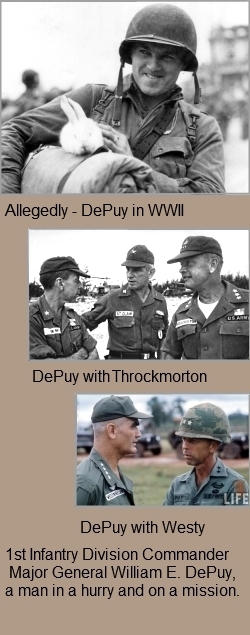
Major
General DePuy turned out to be an aggressive combat leader.
Unlike General McClellan of Civil War fame, who couldn’t get
out of the way of his own shadow, or more precisely,
preferred not to, DePuy had no intention of letting grass
grow under his feet, or rice as the case may have been. His
plan was simple: move fast, hit hard. As a result he
initiated 1st Infantry Division tactics that rapidly
expanded the pace and scope of combat operations, more
quickly and intensely than any prior Vietnam Army commander
had. His troops moved as fast as the famous Generals Sherman
(again, of Civil War fame) and Patton (WWII), and possibly
faster, even without taking into account the fact that DePuy
rode on choppers while the best they had were horses and a
tank.
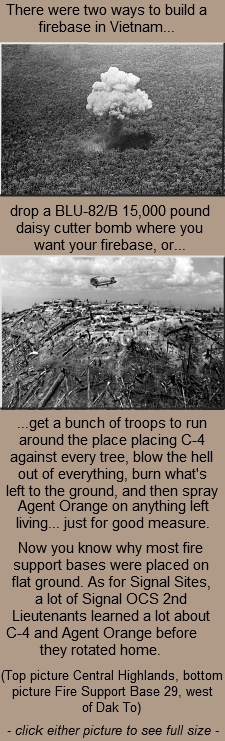
With DePuy it was not unusual to see a command post and a
few fire support bases appear one day, only to be moved the
next. DePuy’s approach correlated his troops physical
presence to the potential for action, putting his men in the
line of fire whenever he could, rather than waiting for the
line of fire to come to him. It may be an old infantry adage
that if you hear the sound of gunfire, head toward it, but
if it is, DePuy lived these words. He wanted to engage the
enemy and he expected his troops to move to do so whenever
the opportunity arose, even if that meant fighting while on
the move.
With this kind of an attitude what could the Signal boys do
but find new ways to not only keep up with him but prove
their mettle too by outpacing the ground pounders. This
caused them to have to come up with even more rapid
ways to deploy the communication assets at their disposal
and get them up and running quicker. In this case though the
problem wasn’t lack of equipment, it was the pace of
tactical combat change. In particular, the unique Vietnam
environment simply made communication at this pace anything
but reliable. The standard process deployment approach that
had been developed simply did not work. To fix the problem
the Signal boys turned to innovation again.
College Changes Everything
Our scholarship donation
campaign for this year is just getting underway. Please take a moment to
view our video at left and consider a donation. Donations in
any amount are accepted, and best of all you can use your
credit card online. Your payment is secure and your donation
is tax-deductible. Please help us help the children of those
who served.
Thank You!
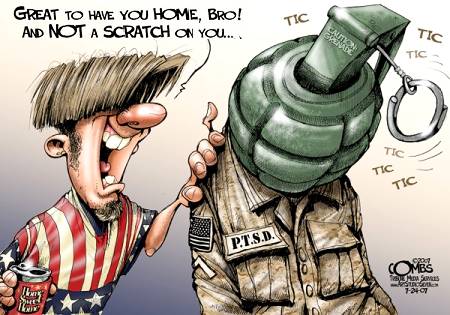
You've heard of it, but if asked, could you give a lucid
explanation of what it is? Its symptoms?
Back in the Civil War it was called Da Costa's Syndrome,
soldier's heart and cardiac neurosis.
People who have it live in a state of elevated adrenaline,
their bodies constantly trying to adapt to normal life but
usually failing.
This is accompanied with bouts of grief and guilt, along
with traumatic bereavement over things they either did, or
worse, things they didn't do. The people who have it often
break into tears, for no reason at all. These factors
combine to cause a rise in guilt until overwhelming grief
hits, at which time the cycle repeats itself... over and
over again.
In 1980 it made its first appearance in the American
Psychiatric Association's edition of the Diagnostic and
Statistical Manual of Mental Illness.
After the Civil War the terminology for it moved on and it
was no longer called
Da Costa's Syndrom. By World
War I it was called shell shock. By World War II it was
being called war neurosis. In Korea it
was referred to as gross stress reaction.
Today it's called PTSD.
The best treatment for it seems to be cognitive
behavioral therapy, a form of exposure therapy using virtual
reality. Sometimes narrative therapy seems to work too.
When treatment does not go well, or when there is no
treatment at all, relationship problems rise to the
surface, accompanied by misdirected and uncontained
behavior, and often violence. And as though this is not
enough, employment issues usually walk in lock step with
each of these things.
According to the VA, 30 percent of Vietnam vets have
Post-Traumatic Stress Disorder, compared with 10 percent
from the Gulf War and Operation Desert Storm. The VA's
National Center for Post-Traumatic Stress Disorder predicts
that 11 to 20 percent of veterans of the current wars will
be affected.
And it doesn't go away. Last month while finally getting
around to signing up for the VA's Agent Orange Registry
program a doctor at the San Diego VA facility diagnosed this
author with PTSD. Forty-four years after returning from
Vietnam some hack with an MD after his name tells me I have
PTSD? Seriously? Is he kidding? You mean that's the
explanation for the alcoholism, endless family fights,
multiple marriages, DUIs, driving to endanger, nightmares,
persistent challenging of authority, lack of satisfaction
with life, constantly taking my anger out on friends,
excessive acting out over the most trivial of issues,
ability to shut people out of my life in an instant, extreme
cynicism, overall ugly disposition, and curmudgeonly
attitude? PTSD?
Heck... and I thought those were the character traits that
made me loveable.
Psssst...
if you've got it, get help. Even after all these years it's
not too late.
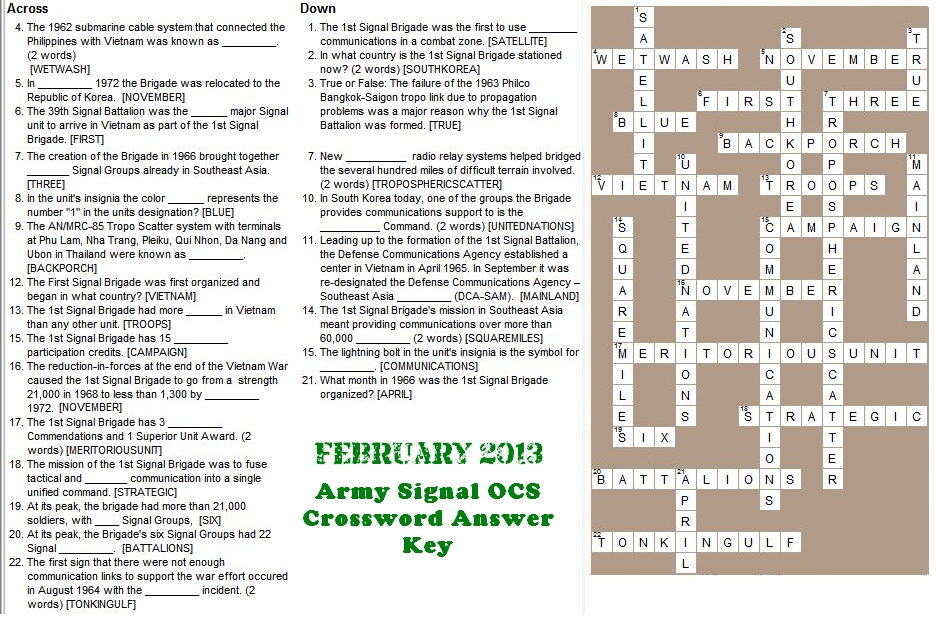
February's Crossword Puzzle
Theme:
1st Signal Brigade
Hint:
Join 2 and 3 word answers together as one complete word.
For
answer key to this month's puzzle,
see icon at bottom of page
Footnotes:
[1] Sources and cross check for comments about
non-notification of government of South Vietnam:
— Neil Sheehan,
Hendrick Smith, E.W. Kenworthy, and Fox Butterfield, eds.,
The Pentagon Papers (New York: Bantam Books, 1971)
— William Bundy’s
unpublished manuscript, chapter 19, as read and commented on
by Bui Diem, member of the delegation to the 1954
Geneva conference,
Chief of Staff to the Premier of South Vietnam, 1965, et al.
— U. Alexia Johnson,
The Right Hand of Power (Englewood Cliffs, N.J.:
Prentice-Hall, 1984)
- To return to your place in
the text click here:
[2] For a well written, brief history of the 173rd in
Vietnam, see this Wikipedia article:- To return to your place in
the text click here:
[3] EL PASO II, HAWTHORNE, PAUL
REVERE, SILVER BAYONET, MASHER/WHITE WING [Click here
for
map of combat operations] - To return to your place in
the text click here:
Search Instructions:
To perform a
quick search for a VIETNAM, KOREA or WWII era class (such
as: 7-66),
a graduate (such as: Green), or a site search, follow
this example:
A search, for example, for Richard
Green, will result in all the "Richard" entries,
all the "Green" entries, and all the "Richard Green"
entries.
Original Site Design and Construction
By John Hart, Class 07-66. Ongoing site design and
maintenance courtesy Class 09-67.
Content and design Copyright 1998 -
2013, ArmySignalOCS.com
This site is updated as we
receive new material. Please check back frequently. For your
security, please read our Website Privacy & Use Policy by
clickinghere.










 That
was the case for the 3,500 Marines
that landed at Đà Nẵng on March 8, 1965... and it was also
the case for the 20,000 support
personnel that were ordered to Vietnam on April 1, 1965, as
well as
the order issued on April 14 to deploy the entire 173rd Airborne
Brigade. For a war that was supposed to be about Uncle Sam
working hand in hand with the South Vietnamese government to gain control of the country,
upgrade the skills of the ARVN, help the ARVN oust the NVA and V.C.,
and set up a democratic system of government,
Westmoreland sure was keeping his "partner" in the dark
about his intentions.
That
was the case for the 3,500 Marines
that landed at Đà Nẵng on March 8, 1965... and it was also
the case for the 20,000 support
personnel that were ordered to Vietnam on April 1, 1965, as
well as
the order issued on April 14 to deploy the entire 173rd Airborne
Brigade. For a war that was supposed to be about Uncle Sam
working hand in hand with the South Vietnamese government to gain control of the country,
upgrade the skills of the ARVN, help the ARVN oust the NVA and V.C.,
and set up a democratic system of government,
Westmoreland sure was keeping his "partner" in the dark
about his intentions. 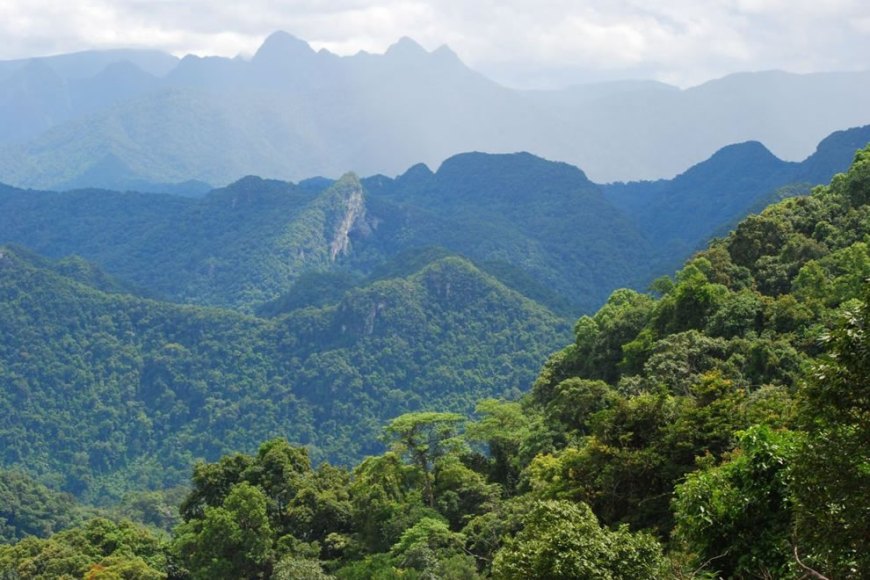
 This
became evident when the first major combat
element to arrive in Vietnam, the 173rd Airborne
Brigade, discovered that it was having a devil
of a time communicating over extended distances
of any kind. In this case both local terrain
conditions and unit dispersal proved to be the
problem, for while the 173rd's troops were in
Vietnam their logistics base was in Okinawa. All
told, communication between the units HQ, their
logistics base in Okinawa, and their forward
bases in the field proved to be a bridge too far
for the signals equipment being relied on.
This
became evident when the first major combat
element to arrive in Vietnam, the 173rd Airborne
Brigade, discovered that it was having a devil
of a time communicating over extended distances
of any kind. In this case both local terrain
conditions and unit dispersal proved to be the
problem, for while the 173rd's troops were in
Vietnam their logistics base was in Okinawa. All
told, communication between the units HQ, their
logistics base in Okinawa, and their forward
bases in the field proved to be a bridge too far
for the signals equipment being relied on.  Posted 1
February 2013
Posted 1
February 2013


 By 1968 every airborne
commander wanted his own command and control
chopper, outfitted with every radio he could get
his hands on. It was as though every LTC and above
had discovered the thrill of Ham radio. And of
course, the Signal Corps obliged, by introducing
the AN/ASC11, followed by the AN/ASC15. About
the time the war started to go flat again (1970
By 1968 every airborne
commander wanted his own command and control
chopper, outfitted with every radio he could get
his hands on. It was as though every LTC and above
had discovered the thrill of Ham radio. And of
course, the Signal Corps obliged, by introducing
the AN/ASC11, followed by the AN/ASC15. About
the time the war started to go flat again (1970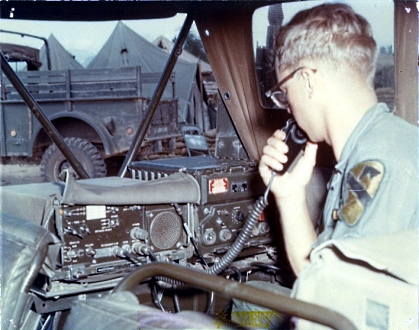
 For
one of these campaigns the 1st Infantry Division (commanded
by Major General William E. DePuy) fielded an operation
called EL PASO II. It began on 2 June 1966, and depended for
its success on the solution to some weighty communication
problems… of both a logistical and operational nature.
For
one of these campaigns the 1st Infantry Division (commanded
by Major General William E. DePuy) fielded an operation
called EL PASO II. It began on 2 June 1966, and depended for
its success on the solution to some weighty communication
problems… of both a logistical and operational nature. 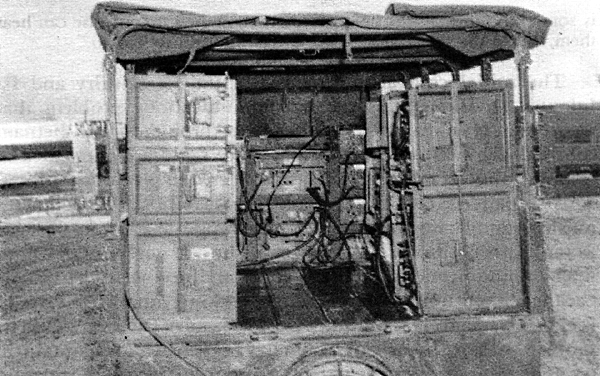
 Major
General DePuy turned out to be an aggressive combat leader.
Unlike General McClellan of Civil War fame, who couldn’t get
out of the way of his own shadow, or more precisely,
preferred not to, DePuy had no intention of letting grass
grow under his feet, or rice as the case may have been. His
plan was simple: move fast, hit hard. As a result he
initiated 1st Infantry Division tactics that rapidly
expanded the pace and scope of combat operations, more
quickly and intensely than any prior Vietnam Army commander
had. His troops moved as fast as the famous Generals Sherman
(again, of Civil War fame) and Patton (WWII), and possibly
faster, even without taking into account the fact that DePuy
rode on choppers while the best they had were horses and a
tank.
Major
General DePuy turned out to be an aggressive combat leader.
Unlike General McClellan of Civil War fame, who couldn’t get
out of the way of his own shadow, or more precisely,
preferred not to, DePuy had no intention of letting grass
grow under his feet, or rice as the case may have been. His
plan was simple: move fast, hit hard. As a result he
initiated 1st Infantry Division tactics that rapidly
expanded the pace and scope of combat operations, more
quickly and intensely than any prior Vietnam Army commander
had. His troops moved as fast as the famous Generals Sherman
(again, of Civil War fame) and Patton (WWII), and possibly
faster, even without taking into account the fact that DePuy
rode on choppers while the best they had were horses and a
tank.