From
MI-8 to the NSA - The Evolution Of Signals
Intelligence "Gentlemen Do Not
Read Other Gentlemen’s Mail"
This is the continuation of a story begun on our January 2014 Home Page. To
go to an archived version of that page, click here: January
2014 Home Page Archive. To return to this
month'sactual Home Page, click on the Signal Corps
orangeHome Page menu item in the
upper left corner of this page.
continuing...
By November 1918 MI-8 had grown to consist of 18 Officers,
24 civilian cryptographers and cryptanalysts, and 109
typists and stenographers; or seen another way, it was now
beginning to show up on the radar screens of many in
Washington who were beginning to ask questions about who
these people were, what the group’s function was, what
purpose it served, and where it got its money. Yet while
those seeking power began to circle around the group, like
vultures at the site of a new born coyote not yet able to
stand on its own feet, the group went on about its job…
decoding the messages sent to it and creating ciphers for
use in the field.
Those of you reading closely will have noticed by now that
while the work the group did was praiseworthy, from today’s
viewpoint it was severely circumscribed. For example,
nowhere in the list of duties the group had was there
mention of responsibility for conducting radio intercept
work, as a source of raw material for cryptanalysis. The
reason for this was that radio intercept of fixed station
broadcasts fell under the auspices of the Army, and the
Signal Corps in particular. Part of the reason for this was
that during this early period in the evolution of signals
intelligence (SIGINT) and communication interception
(COMINT) the amount of radio traffic able to be intercepted
was fragmentary at best. Another reason was that at that
time large governments preferred to use cable and wire
communication, because they felt it was more secure. When
one adds to this the simple fact that regardless of the
circumstances radio as a means of communication between
widely separated fixed stations was then still in its
infancy, one can see why the crypto guys stuck with crypto
and left the radio stuff to the radio boys in the Signal
Corps.
The
Signal Corps on the other hand, while responsible for
communication interception, found itself able to do only a
rudimentary job at best, primarily because of budget
limitations. Nevertheless, to make sure that what could be
vacuumed up was, the Signal Corps set up a series of what
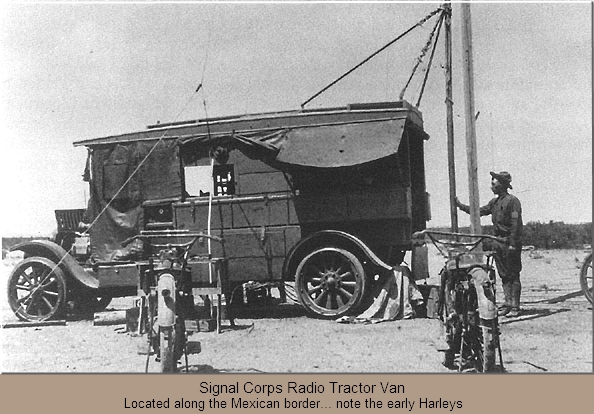
were called “mobile tractor” or “radio tractor” units.[1]
These mostly wheel (not tractor) driven trucks with radio
vans on their back were stationed along the southern border
with Mexico (during WWI), in Cuba, the Philippines, and even
in Houlton, Maine (set up in late 1918).
Operated by the Signal Corps but officially designated as
the Radio Intelligence Service section of the U.S. Army
Military Intelligence Branch, the Mexican border operations
represented both the military and the country’s first
attempt at radio interception. In the case of Mexico, the
concern was to validate whether Mexico was moving towards
siding with Germany in World War I or not.
One of the things we were able to learn from a declassified
portion of the NSA’s own Regional Section History was that
they take credit today for this effort of the Signal Corps
back then… implying that this effort helped make the case
that an NSA like agency was needed to conduct this kind of
work, instead of just trusting it to a branch of the
military like the Signal Corps. In this case they discussed
the placement of Radio Tractor Units 33 and 34 in McAllen,
Texas, as though the NSA did the work... decades before it
ever came into existence. It's always interesting to note
that within our wonderful government and the many agencies
it has spawned, when it comes to claiming glory, it's
amazing how quickly the lines between different agencies
become blurred.
In an interview with one of the service men who manned these
listening posts it was disclosed that the Signal Corps’
McAllen listening post had the task of tracking radio
communication emanating from Chapultepec, Mexico.
Chapultepec (its local call sign back then was XDA), it
turns out, was in near constant communication with both
stations in Germany and German submarines in the Gulf of
Mexico.
For the most part, because everything was being encoded, all
the men in these Radio Tractor Units could do was collect
data on what time of day Chapultepec “came on the air, who
was being called, and what the code was.” As the NSA’s
declassified documents reveal, “There was an awful lot of
code that came out of Chapultepec and… a lot of it was
copied and passed to Washington. [T]he material… transmitted
back to Washington… was very valuable.”
The NSA’s report went on to say that the Chapultepec station
was an extremely powerful station but that regardless of its
strength the Signal Corps’ Radio Tractor Units were fully up
to the task of collecting the information they needed. Since
all of the radio listening equipment was already installed
inside of the vans, and connected, all the men had to do to
go online was raise the umbrella antenna the system used.
This they did by taking the spikes out and hoisting it.
After that a tent was set up, a field strength meter was
hung on the wall so that signal strength could be read, and
finally an “audibility” meter was set up too. The actual
work the men did in listening in on the target radio station
consisted of taking readings on a station’s signal strength
until a transmission pattern could be detected. With this
pattern they were then able to estimate the size and
direction of the signal lobe, from which they could then
reverse track and pinpoint where the station's signal was
coming from. This was done through basic triangulation via
having two or more Radio Tractor Units working together,
each rotating their radio signal detection loop antennas
around until they could pinpoint the transmitting station’s
strongest and weakest signal points. All of this was done
manually, with the antenna being turned by hand. To identify
signal strength azimuth(s) a disc with degrees marked on it
and an arrow able to be set at particular points was used.
By itself the radio receivers of the
radio detection equipment the Signal Corps supplied were not
regenerative. To improve on their ability to receive the
signals being tracked the crews usually built their own
‘Armstrong regenerator circuit’ and attached it to the
receiver.[2] Consisting of
little more than two coils, of which one was fixed and the
other moveable, Hams of the day could easily put one of
these together so that the moveable coil was fastened onto a
piece of wood that let the user push it in and out until
optimum signal strength was found.
While a little bit of ingenuity was required to do the work,
duty on a Radio Tractor Unit was not tough duty. Men were
assigned in shifts, so that the station operated twenty-four
hours a day. Supplies of extra tubes and other equipment
were kept on hand and generally speaking the equipment was
never shut off unless something went wrong and the only way
to fix it was to shut it down.
Security wise, the units stationed in the U.S. were assigned
at least one .38 caliber handgun, intended primarily to
protect the men against rattle snakes.
In the end, as we know today, while Mexico got pretty cozy
with the Germans in WWI they did not form an alliance with
America's enemy. If they had then the Signal Corps, via its
Radio Tractor Units along the Tex-Mex border, would have
been the first to know.
The
Radio Tractor Units set up in Houlton, Maine, on the other
hand were responsible for copying trans-Atlantic radio
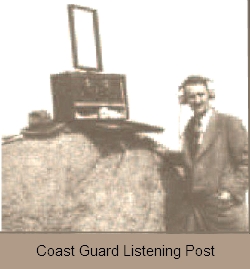
traffic. Supplementing these were listening posts manned by
the Coast Guard, as well as a few more Radio Tractor Units
that were set up as part of the Allied Expeditionary Force
(AEF) efforts in Europe, and one or two more that ended up
in the Siberian operations. Both the AEF and Siberian
listening posts turned out to be a disappointment to the
guys in MI-8, as they failed to provide much useful
intelligence, although they did furnish a large quantity of
diplomatic traffic that the State Department delighted in
reading. Unfortunately, while the MI-8 team and the Signal
Corps both thought it useful to proceed with this effort
post WWI, as soon as the war was over the budget for these
activities was yanked and the majority of the sources for
radio intercept in Europe were closed down.
By 1929 the flow of messages furnished to the G-2 at MI-8
had dwindled to a mere trickle… with most coming from Coast
Guard intercept stations, the one remaining station in the
Philippines, and a couple of other radio intercept locations
that the Signal Corps was able to keep operating with its
decimated budget. What the budget hacks failed to see from
the information that was coming from these radio intercepts
was that, fragmentary as it was, the quality of it was good
enough to warrant a serious attempt be made to obtain better
material, by building both more and better placed intercept
stations. Unfortunately, this chicken would not come home to
roost until Pearl Harbor, when it would become clear to all
that there was value in signals intelligence, communications
interception and crypto and cipher activities. At that time,
as in so many other cases—after the horse had left the
barn—Congress would make the funds available. Until then
though it was up to the State Department to keep reaching
into its pocket to underwrite the War Department–Signal
Corps’ MI-8 efforts.
In terms of the road that led to the creation of the NSA,
1929 proved to be a pivotal year, for although the formation
of the NSA was still decades off in the future its
foundation was being laid in 1929. In the summer of 1929
Major O.S. Albright, a Signal Corps man, was assigned to G-2
to serve on the staff of the Acting Chief of Staff, to
supervise and coordinate the cryptographic and cryptanalytic
activities that still remained as the great military efforts
of WWI were being wound down.
In typical fashion for an incoming Signal Corps Officer, he
mounted a detailed study of the situation as it stood,
appraising not just how the existing cryptanalytic bureau
was doing its job, but most especially what jobs it should
be doing but wasn’t. In quick order he came to the
conclusion that not only was the structure of the
organization not suited to the task it was performing but
that its mission was amiss too. One of the things that
concerned him most was that the daily publication of the
results of the analytic work done, something known
internally as the ‘bulletin’, while of great interest to the
State Department, held little value for the War Department.
As far as the War Department was concerned the only thing it
was getting out of the entire MI-8 effort was the ability to
train personnel towards the goal of developing ‘war-time
effectiveness.’
As Major Albright saw it, if that was
the goal the War Department wanted, then that was fine…
except for one thing: there was very little if any training
going on. Further, if there was any thought of using the
people already in the group to support War Department
efforts in the event of another war then that too was out of
the question, as all except for one clerk were beyond the
age where they could be drafted and/or serve a useful
purpose in an actual war zone. When this was added to the
fact that the unit was being run like a civilian
corporation,[3]
one hidden away in an office building in New York and beyond
the most basic of military supervisory capabilities, it all
began to look more like a country club than a section in the
War Department. This, plus a few conflicts of interest
between the MI-8 unit and the people who ran it, especially
with regard to their ability to divert its work towards
projects that helped them pocket money of their own… as well
as a propensity to disclose some of its secrets in order to
earn civilian contracts that were then done on the side,
caused Major Albright to become apoplectic.
Being the good Signalman that he was, he detailed his
charges and recommended to the Acting Chief of Staff that
the bureau be taken out of G-2 and its functions transferred
in full and permanently to the Signal Corps. In support of
Major Albright’s recommendations Lieutenant Colonel W.K.
Wilson of the War Plans and Training Section of G-2 prepared
a memorandum of his own on the same subject, and essentially
but unknowingly endorsed the conclusions reached by Major
Albright. The result was that in April 1929 G-2 and the
Chief Signal Officer implemented Major Albright’s
recommendations, at which time the U.S. Army Signal Corps
officially became responsible for all SIGINT, COMINT,
cryptanalysis, code, and cipher work, as well as the
printing, storage, distribution, and accounting of codes and
“in time of war the interception of enemy radio and wire
traffic, the goniometric location of enemy radio stations,
the solution of intercepted enemy code and cipher messages,
and laboratory arrangements for the employment and detection
of secret inks.”
Or so that was the plan. Unfortunately, before anything
could be done to actually transfer the activities of the old
MI-8 unit to the Signal Corps another piece of fruit hit the
fan. In November the country held its
1928 Presidential elections and in March 1929 the
administration that was elected took office. In that
administration was a certain Mr. Henry L.
Stimson, who
became Secretary of State. No pacifist dove, Stimson served
under President Herbert Hoover (Republican), where he
articulated what became known as the Stimson Doctrine. The
Stimson Doctrine loudly proclaimed, and in strong terms,
America’s opposition to Japan’s expansion in Asia.
Not willing to let these laurels be the
only conservative ones he rested on, later in life he went
on to serve as Secretary of War (1940–1945) under Franklin
D. Roosevelt (Democrat), where his true hawk colors emerged
as he called for war against Germany. In this capacity, as
Secretary of War, he personally involved himself in the
country’s effort to raise and train over 13 million soldiers
and airmen to fight WWII, oversaw the spending of a third of
America's GDP in an effort to rebuild the Army and build a
new Army Air Force, helped formulate military strategy, and
took personal control of the effort to both build and use
the atomic bomb. Stimson was a dynamo and a true blooded
American. Unfortunately, he was also a blue blooded
American, whose ethical roots stemmed from an erudite,
Brahmin education that left no doubt that the world should
be ruled by gentlemen, and that gentlemen should at all
times be gentlemen.[4]
In May 1929, to help ease his transition into office and
assure that he was not overwhelmed by the amount of decision
making that he needed to make as the new Secretary of State,
his ‘handlers’ decided to forgo giving him copies of the
daily ‘bulletins’ that the cryptanalytic bureau in New York
was producing. They felt that after he had had sufficient
time to get up to speed on the important issues they would
then introduce him to these lesser matters. And so it came
to pass that late in April he found on his desk a series of
decrypted messages that originated within the highest levels
of the Japanese government. When he asked where the
information came from, and was told about MI-8 and its
activities… and when he heard the story... he went nuclear.
Not just nuclear, but violently nuclear.
With no
equivocation at all he characterized the activity of
secretly capturing other gentlemen’s mail as being highly
unethical and declared that in his State Department this
kind of activity would cease immediately. His famous quote
rings down through history until today, “Gentlemen don’t
read other gentlemen’s mail.” One can only wonder what he
would make of our beloved NSA’s activities, trawling through
every communication of every citizen of America… and the
world when it can… for interesting tidbits. One wonders too
what he would think of the ethics of the President’s that
lead our country, listening in on the cell phone
conversations of the wives of many of the world's leaders. By Stimson’s measure, would they qualify
as gentlemen?
Immediately upon declaring that these
activities would stop he gave clear instructions that no
funds from the State Department would henceforth be spent in
support of the SIGINT, COMINT, or cryptanalysis work being
done, nor would they be made available for either the MI-8
operation or the planned replacement operation that the
Signal Corps was setting up. To be fair to him, within the
next few weeks he softened his orders somewhat when he came
to understand that if followed they would put out of work
several people who, in the middle of the recession that was
then raging, had no employable skills at all… except for an
uncanny ability to break Japanese and German codes. It's
interesting from this period of time to look back and see
that while he held firm on his principles, he wavered in his
actions in order to keep people employed during the
recession. And as
for his famous quote and its clarion call to civilization to
make this a better world, he later allowed that while he
held his views for moralistic reasons, he understood and did
not deny that in time of war certain practices that might be
morally wrong and even repugnant in peace time would prove
necessary then.
In the end, even though he tried so save their jobs, Stimson’s decision to
pull the funding from the signals intelligence program and
the War Department’s decision to move its operations over to
the Signal Corps eventually caused the people of the old
MI-8 to be given three month’s pay and let go. Looking at
this too from today’s viewpoint, especially in light of the
wobbly ethics that people hold these days, the decision to fire
the MI-8 people was both brave and stupid. It was brave in that
it showed our government at a time when it did what it knew
it needed to do, regardless of the consequences… surely
something that would not happen today, where every decision
is weighed against the probability of its impact on politics
or someone or some party’s prospect for reelection. And it
was stupid in that it failed to take into consideration the
risk of alienating the civilians involved.
What risk of
alienation, you ask?
Consider if you will that while the
three month’s separation pay offered to the cryptanalyst
staffers was generous, all involved knew that these people
were not likely to find another job when the money ran out…
and further that since they were civilian employees they had
no civil service status. This meant that they had no
unemployment benefits to draw on, no retirement benefits, no
health or welfare insurance, and didn’t qualify for
government aid or help. And while you are considering all of
these things, consider too the secrets they knew. What, pray
tell, would an Edward Snowden do if he were put in that
situation today? Most likely he would neatly wrap up his
penurious situation and take it to the Russian, German or
Japanese consulate, where in all likelihood he would, back
then, have found
instant and gainful employment—if only reporting on what he
knew we knew about what they knew.
But that was not the case
in 1929. In 1929 people like Secretary of State Stimson had
ethics, as did the civilian cryptographers, cryptanalysts,
typists and stenographers of the old MI-8.
- - -
With that
MI-8 became a part of American history. The State
Department too, being out of the data analysis business but
still an avid reader of those bits it could get its hands
on, took a back seat to what was going on in order to make
room for the next group of players on the scene. The
transition was quick and simple for
the War Department and its Military Intelligence Division—by the end of 1929 their MI-8 brainchild was only a memory.
In its place stood the new Signals Intelligence Section
(SIS).[5]
Officially formed in 1930, its purpose was to
consolidate all military cryptologic functions and signal
intelligence efforts under the U.S. Army Signal Corps. A
fully integrated section with authority to get involved in
any area required in order to do its mission, the SIS soon
found itself caught up in not only producing the Army 's own
codes and cipher devices, but attempting to capture and
decrypt the communications of America's potential
adversaries… including those within allied governments that
America had its suspicions of… this latter point being a
task left over from the earlier days when this kind of work
was being done at the behest of the State Department.
One
can only wonder, sitting here today, if this early blurring
of the lines between friend and foe is what led to today’s
idea that if you can hear it you can record it and
listen to it. Putting the matter of Uncle Sam listening to
all of us American civilians aside for the moment, was the
early blurring of the lines that caused the U.S. to listen
in on its ally’s communication back in 1930 the progenitor
of the NSA’s effort in 2011 to convince Australia’s
Australian Signals Directorate agency to tap the personal
cell phone of the wife of the President of Indonesia, or
George Bush’s infatuation with listening to Chancellor
Merkel of Germany’s personal phone calls?[6]
Didn’t anyone at any time along the way stop to realize that
while all would decry the treachery of someone like a
Snowden leaking SIGINT and COMINT secrets, the damage to
America’s reputation would be far worse than the crime
committed by him if he exposed to the world the fact that
America was listening in on not just its own allies and
friends, but its own citizens? Didn’t anyone realize that by
our country listening to its own friends and its own people
irreparable harm would be done to our image? And while we
are at it, didn’t anyone realize that
no amount of top secret security clearance checks was or is going
to keep out of the woodpile that one Indian that will tell
the world what is really going on inside the NSA? Didn’t
they know that this secret of us listening to us was eventually going to come out?
And didn’t they realize that once it did, from that point
forward it would be America’s ethics that would appear
wobbly on the world stage, not those of the Edward Snowden’s
of the world?
Damned them and damned their kind… hypocrite
bureaucrats more focused on power than principles. Becrie
the stupidity of humanity! What has happened to this country
when for the sake of a few tips on what the wife of the
President of Indonesia is thinking, or whether the President
of Germany is for or against a new trade agreement, our
leaders are only too happy to sell down the drain the
integrity of this country… our country… MY country!
Profanity and histrionics aside… let us return
to our story…
As the calendar turned from 1929 to 1930 and a
new decade commenced the U.S. Army Signal Corps found itself
firmly in control of America’s SIGINT and COMINT spy
business. Organizing itself for the road ahead it promptly
published a series of influential studies on cryptology,
which it then used to pioneer the development of machine
ciphers of unparalleled sophistication and security. From a
military standpoint at least, the Signal Corps’ efforts
brought true security to military communications for the
first time in its history. This, plus the training courses
it began to put in place, the effort it began to mobilize a
base of Officer leaders able to lead the charge if a call
came for wartime expansion, and especially its establishment
of a network of radio intercept stations around the world…
something the Army had never had during peacetime, placed
the Signals Intelligence Section of the Signal Corps in
position to give America what it needed most: effective ears
on the world.
Let us stop here, in 1930. In our next article, Part II – Intelligence,
we will continue the story of SIGINT and COMINT—from 1930
through to 1945 and the end of WWII.
To pique your interest
we will begin with one of the greatest accomplishments the
Signals Intelligence Service ever had: the breaking of the
Japanese PURPLE machine cipher, in 1939, using purely
cryptanalytic methods developed by the U.S. Army Signal
Corps. Want to know the true story of how the PURPLE code
was cracked, and who did it? Please join us in Part II.
Footnotes
[1] This author believes that the terms ‘signal tractor
unit’ and ‘radio tractor unit’ that have come to be used to
describe these vehicles are in reality bastardizations of
the more correct term signal or radio tracking
unit. During the WWI period it was common for military
materials to be moved around a battle space by tracked
vehicles that were called tractors. This was especially the
case with the Signal Corps, which placed much of its
communication equipment in trailers for movement to various
field locations. Since most of these combination
tractor–trailer vehicles were referred to as 'tractor
units,' more likely than not when the vehicles designated as
‘Radio Tracking Units’ began to arrive in the field their
name was shortened to fit the colloquial expressions of the
time. As a result they became known as radio ‘tractor’ units
instead of by their rightful name of Radio ‘Tracking’ Units.
Notwithstanding this, there is no doubt that on Army unit
lists of inventory they are listed as Radio Tractor
Units. Thus, one can find listed as being assigned to
McAllen, Texas, in 1918, “Radio Tractor Units 33 and 34”.
- To return to your place in the text click here:
[2] The Armstrong coil was named for Edwin H. Armstrong, an
inventor and a major in the U.S. Army Signal Corps during
World War I. He is most famous for having developed a new
method of modulation that reduced the effect of ignition and
other noises encountered in radios used in military
vehicles.
- To return to your place in the text click here:
[3] The unit listed itself on the office building’s name
plate as the ‘Code Compilation Company.’ This name was
allegedly chosen for security purposes.
- To return to your place in the text click here:
[4] The term Brahmin is most normally
used to refer to a member of Boston's
traditional upper class. It has nothing
to do with India. Members of the East
Coast’s Brahmin class are characterized
by their extremely discreet, out of the
limelight, inconspicuous lifestyle. To a
true Boston Brahmin people like the
Kennedys are just upstarts, and noisy
uncultured ones at that. Members of
Boston's Brahmin class form an integral
part of the historic core of the East
Coast establishment and are often
associated with the distinctive Boston
Brahmin accent (… Baaaastin…) and Harvard
University (… Haaaavaad…), and traditional Anglo-American
customs and clothing. Descendents of the earliest English
colonists (i.e. those who came to America on
the Mayflower or the Arbella), these people are
often considered to be the true elite of
1930s America.
- To return to your place in the text
click here:
[5] The Signals Intelligence Section (SIS) and its acronym
are also often referred to as the Signals Intelligence
Service.-
To return to your place in the text
click here:
[6] Allegedly at the request of the NSA,
the Australian Signals Directorate
tapped the phones of the wife of
Indonesia’s President Yudhoyono. From
the Guardian (U.K.) newspaper,
article titled Anger in Indonesia over 'illegal'
Australian phone tapping attempt;excerpt
–
"Former Indonesian vice-president says:
'We don’t expect that our friend will be
tapping our personal communications' " …
"The Abbott government is trying to calm
the angry reaction in Indonesia to the
revelations that Australia's spy
agencies attempted to listen in on the
personal phone calls of the Indonesian
president, Susilo Bambang Yudhoyono, and
targeted the mobile phones of his wife,
senior ministers and confidants." Link
to Guardian article:
- To return to your place in the text
click here:
Additional Sources
Special Research History # 134, Expansion of the Signal
Intelligence Service from 1930-7, December 1941; Herbert O.
Yardley, with titled documents including The American Black Chamber, (Indianapolis: Bobbs-Merrill,
1931); David Kahn , The Codebreakers: The Story of Secret
Writing (New York: The Macmillan Company, 1967).
Allied Expeditionary Forces (AEF): Active
May 3, 1917 - 1919. Click here for external link and
information:
Additional Special Research History
unpublished documents:
William F. Friedman, The Friedman Legacy.
David Kahn,
The
Reader of Other Gentlemen's Mail.
Henry L. Stimson,
On
Service in Peace and War.
Herbert O. Yardley,
The American
Black Chamber.
Like
this article? Let us know by helping us with our scholarship fund efforts. A
$30.00 donation
to our
Scholarship Fund
will help us get one step closer to helping another deserving High School
graduate attend college. Your donation is tax deductible and your kindness
will go father than you think in making
it possible for another young American to fulfill their dream of a college
education. Thank You!
Original Site Design and Construction
By John Hart, Class 07-66. Ongoing site design and
maintenance
courtesy Class 09-67.
Content and design Copyright
1998 - 2014 by ArmySignalOCS.com.







 The
Radio Tractor Units set up in Houlton, Maine, on the other
hand were responsible for copying trans-Atlantic radio
traffic. Supplementing these were listening posts manned by
the Coast Guard, as well as a few more Radio Tractor Units
that were set up as part of the Allied Expeditionary Force
(AEF) efforts in Europe, and one or two more that ended up
in the Siberian operations. Both the AEF and Siberian
listening posts turned out to be a disappointment to the
guys in MI-8, as they failed to provide much useful
intelligence, although they did furnish a large quantity of
diplomatic traffic that the State Department delighted in
reading. Unfortunately, while the MI-8 team and the Signal
Corps both thought it useful to proceed with this effort
post WWI, as soon as the war was over the budget for these
activities was yanked and the majority of the sources for
radio intercept in Europe were closed down.
The
Radio Tractor Units set up in Houlton, Maine, on the other
hand were responsible for copying trans-Atlantic radio
traffic. Supplementing these were listening posts manned by
the Coast Guard, as well as a few more Radio Tractor Units
that were set up as part of the Allied Expeditionary Force
(AEF) efforts in Europe, and one or two more that ended up
in the Siberian operations. Both the AEF and Siberian
listening posts turned out to be a disappointment to the
guys in MI-8, as they failed to provide much useful
intelligence, although they did furnish a large quantity of
diplomatic traffic that the State Department delighted in
reading. Unfortunately, while the MI-8 team and the Signal
Corps both thought it useful to proceed with this effort
post WWI, as soon as the war was over the budget for these
activities was yanked and the majority of the sources for
radio intercept in Europe were closed down.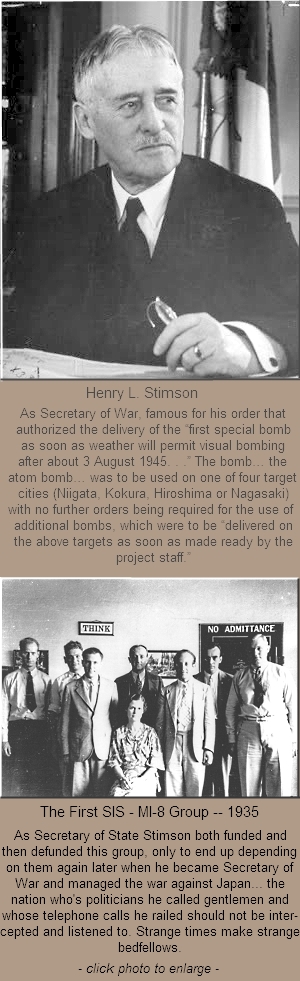 Or so that was the plan. Unfortunately, before anything
could be done to actually transfer the activities of the old
MI-8 unit to the Signal Corps another piece of fruit hit the
fan. In November the country held its
Or so that was the plan. Unfortunately, before anything
could be done to actually transfer the activities of the old
MI-8 unit to the Signal Corps another piece of fruit hit the
fan. In November the country held its