Continued from the June 2012 Home Page. To go to an archived version of
that page, click here:
June
2012 Home Page Archive. To return to this
month's actual Home Page, click on the Signal Corps
orange Home Page menu item in
the upper left corner of this page.

continuing...
 According
to Philippine newspapers, at about this time the Philippine
government approached the U.S. government for help. If one
can believe what was reported in the Manila papers, apparently the
U.S. merely smiled wryly and effectively said “I told you
so.” In other words, back when you (Filipinos) were hell
bent on tossing our navy out of your country you should have
listened to us… especially the part about you not being
ready to stand on your own when it comes to defending your
sovereignty—and the other part too, when we told you that your
ever so kind and friendly neighbors couldn’t wait for you to
toss America out, so that they could step in and scoop up
the oil and gas exploration and exploitation rights to the Spratly and Paracel islands. Now you’re on your own. You
deal with it. There’s nothing we can do. Good luck.
According
to Philippine newspapers, at about this time the Philippine
government approached the U.S. government for help. If one
can believe what was reported in the Manila papers, apparently the
U.S. merely smiled wryly and effectively said “I told you
so.” In other words, back when you (Filipinos) were hell
bent on tossing our navy out of your country you should have
listened to us… especially the part about you not being
ready to stand on your own when it comes to defending your
sovereignty—and the other part too, when we told you that your
ever so kind and friendly neighbors couldn’t wait for you to
toss America out, so that they could step in and scoop up
the oil and gas exploration and exploitation rights to the Spratly and Paracel islands. Now you’re on your own. You
deal with it. There’s nothing we can do. Good luck.
Whether true or not, that was the word on the
streets of Manila, Cebu, and the rest of the major cities in the
Philippines.
Time is an amazing thing. No matter how fast it
runs ahead it always seems to bring those it carries along with it back
full circle to where they started from. These days the newspapers in Manila
are full of stories about new changes coming to an agreement called the Mutual Logistics
Support Agreement, signed back in the first days of the War on Terror, between the U.S. and the Philippines… changes which harbor
plans for the U.S. to, once again, permanently base U.S. troops in the
Philippines.
Gosh, we wonder why?
To round out how this came about, the reader will recall that back in 2001
the U.S. embarked on what became known as the War on Terror (official start
date: 7 October 2001). Included in that war effort were several smaller
frontline efforts intended to root out terrorists who, while they may not
have been a mainline threat back then, had the capacity to be so if they
wished. Among them were the Abu Sayyaf, which was (and still is)
an Islamist separatist group based in
and around the southern Philippine islands of Jolo, Basilan and Mindanao.
To allow the U.S.
to send troops to find and kill
these terrorists, the U.S. and the Government of the Republic of the
Philippines had to find a way around the 1987 constitutional provision that
was added back when the U.S. was tossed out of the Philippines. That
provision banned the presence of foreign troops, and was the
medium that forced the U.S. to abandon Subic, Clark and the other bases that
the U.S. held in the Philippines back in 1992.
Now, in 2001, with the U.S. wanting to get at the
Abu Sayyaf, and the Philippines wanting to help them,
the government of the Philippines had a problem on its hands. While it
wanted U.S. troops, its constitution forbade them. To overcome this minor
inconvenience, Philippine president Gloria Macapagal
Arroyo invoked the earlier 1951 Mutual Defense Treaty between the U.S. and
the Philippines, and used it to create a pretext for the
signing of what was known as the Visiting Forces Agreement, followed shortly
thereafter by the Mutual Logistics Support Agreement (MLSA), in 2002.
With this agreement done and out of the way,
America’s Army was on its way back to the Philippines… this time perhaps for good. It might
have taken 10 years to come full circle, but that’s
just what time did. With the first contingent of 600 U.S. military personnel
that arrived in Basilan to train the Philippine military to fight the Abu
Sayyaf the people of the Philippines heaved a sigh of relief. Not out of
fear of the Abu Sayyaf, who were little more than a pain in the side for the
country as a whole, but because Hollywood was back again.
And so it seemed that everyone was
happy... the Philippine people, because Hollywood was back, the US
because it could get at the Abu Sayyaf, and the Philippine government
because they knew that sooner or later they would be able to lasoo the U.S.
into backing their fight with China over the Spratlys.
And so it has happened: from those early days in 2002 until
today the continued pressure by China on the Spratly and Paracel islands
has brought the Philippines closer to America. Where earlier the Philippines may not have
seen a need for a big brother with a big stick, today it sees its need for
U.S. assistance
more clearly. Perhaps as important, today it also knows that if it crafts its written agreement(s) with the
U.S.
properly, it does not have to give up its sovereignty in the process.
 As
for where things stand in the Spratlys, the return of U.S. troops to the
Philippines could not have come too soon. Since April a standoff has been
taking place between China and the Philippines over Scarborough Shoal, in
the Spratlys. Every day or two one side or the other adds another navy
vessel to the standoff. Tension is mounting, people have taken to the
streets in Manila to protest China's bullying, China has forbidden
Philippine tourists from traveling to China, and both sides say they won't
back down.
As
for where things stand in the Spratlys, the return of U.S. troops to the
Philippines could not have come too soon. Since April a standoff has been
taking place between China and the Philippines over Scarborough Shoal, in
the Spratlys. Every day or two one side or the other adds another navy
vessel to the standoff. Tension is mounting, people have taken to the
streets in Manila to protest China's bullying, China has forbidden
Philippine tourists from traveling to China, and both sides say they won't
back down.
At the moment the MLSA,
which allows the US military access to Philippine facilities and a wide
array of services that are typical of American bases (e.g. transportation,
refueling and billeting of troops), is set to expire on November 21, 2012.
And while the agreement is specific about it being a visiting forces
agreement, when reading it one cannot help but think that the access and
service arrangements it grants are nothing short of providing the U.S.
with all of the benefits of a series of formal basis. With the mess Manila
is in as it faces off against China, it is unlikely that they will let the
MLSA expire.
In fact, newspapers in Manila say that the two
sides “may be considering making the MLSA in effect indefinitely and
applicable at any time, even when there are no joint military exercises and
other activities.” Since the earlier Visiting Forces and MLSA agreements
limited foreign troops to having a presence only in the time of war, the new
agreement will amend these provisions, even to the point of allowing the US
to set up military structures and facilities. “Combined with the VFA, which
is in effect indefinitely, the new MLSA will ensure permanent US military
presence in the country,” the news media is claiming.
Of course, the Philippine government is hoping that China is watching
progress on the MLSA, and getting the message that while Manila has no navy
to speak of, it may soon have a big brother sunning itself in its end of the
swimming pool.
As for the people in the Philippines
that originally wanted Uncle Sam to go home back in the '90s, not surprisingly,
they are still around and still all worked up over the issue. The truth be
told,
there is still a significant amount of pushback to the extension and
expansion of the MLSA. Some question why the Philippine government has to
pay for most of the U.S.’s costs, since the war effort that results benefits
the U.S. as well as the Philippines. Others question why “the Philippine
government is obliged to service the needs of US forces and spend for these
before being reimbursed in cash or in kind.” Still others ask why the
agreement is called a “mutual” agreement, since the Philippine military does
not go to the US or any of its facilities to avail itself of similar
services from the US government. “The MLSA is patently one-sided,” they
claim.
All of the complaints and talk aside,
anyone who cares to think about it knows why the Philippines is suddenly
rethinking its need for U.S. troops on its soil. It’s because of China. The
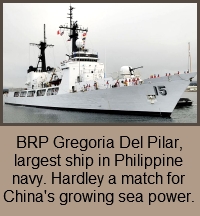
Philippines is no match for China, as was clearly demonstrated when a couple
of Chinese fishing vessels manhandled the Philippine navy out of the way a
few months ago.
According to the
Philippine Department of Foreign Affairs, Albert del Rosario, “it is to our definite
advantage to be exploring how to maximize our treaty alliance with the U.S.
in ways that would be mutually acceptable and beneficial.” He went on to say
that an increased U.S. military presence would help the Philippines in many
areas, including providing a way for the Philippine military to participate
in “more and more frequent joint exercises and a greater number of American
troops rotating through the country.” And while he did not specifically
mention China as driving the Philippines’ push for a greater US military
presence, he did highlight “territorial disputes” as a reason to have the
agreement with the U.S.

- - - - -
Have a comment on this article? Send it
to us. If you are a member of the Association we will
gladly publish it.
If you are not, well, it only costs
$30.00 a year to become a member and have your views heard...
and because
we are a fully compliant non-profit organization, your payment is tax
deductable.





 -
- - - - - -
-
- - - - - -