This is the continuation of a story begun on our July 2013 Home Page. To go to an archived version of
that page, click here: July
2013 Home Page Archive. To return to this
month'sactual Home Page, click on the Signal Corps
orange Home Page menu item in the
upper left corner of this page.
continuing...
Part
of the answer lies in the fact that although the war ended, advancements in
technology did not.
During the early to mid ‘80s the Army tested various
alternatives to the communication nets that the PRC-25 and its successors
made possible, looking for ways to make communication both more prolific,
extensive and reliable. The Army finally settled on something they called
the Mobile Subscriber Equipment (MSE) system, and began rolling it out in
the late 1980s.
Costing something just north of $4 billion, the concept
turned out to be nothing more than a stop-gap measure, as technology's
constant development made the MSE concept obsolete almost before it hit the
field. The idea was to replace older, more conventional multichannel radios
like the PRC-25 with technology only slightly different from that being used
in most civilian mobile telephone (cellular) networks. While this approach
seemed fine on the surface, it showed the problem of the military chasing
every new piece of consumer technology that hit the market. As we all know,
the pace of evolution of the mobile (cellular) communication marketplace was
so fast in the 80s - 90s period that almost anything one might settle on as
a communication standard would be antiquated within five years... and this
is what happened with the Army's MSE system.
In the MSE network radios were supported by
electronic switching nodes, of the kind employed in cellular networks. The
architecture thus allowed each soldier with a radio to have his own
directory number. This allowed calls to be switched automatically to
wherever the warfighter was. Among the benefits this brought was the ability
for command posts to be truly mobile, without having to wait to be either
rewired or networked via a low flying L19/01 Bird Dog or Huey, as was done
in Vietnam.
Tied to all of this were facsimile terminals, which
served as a replacement for teletypes, as well as other input-output
devices. The whole thing was then integrated not only with any switched
telephone networks that existed locally, but the military’s tactical
satellite network too.
For purist readers who are interested in the actual
architecture, the MSE network was laid out in grid form, with a typical grid
having four to six centralized Node centers, which in turn were connected to
switching centers. The switching centers switched the actual calls. They
were also known as extension nodes, as they provided access to the central
Node network where the real digital elements of communication transmission
took place. The Node centers thus formed the backbone or central point of
the network. On paper at least, they were laid out in a hub-like structure,
with the switching centers surrounding the Nodes.
The
network itself, depending on how many switching centers were employed, was
able to cover a battle space of about 15,000 square miles. Within that space
those connected to the switching centers were treated as subscribers. From a
technology standpoint, it did not matter whether subscribers were connected
to the switching centers by radio or by wire, just as long as they were
connected.
Being digital, secure, highly flexible, and containing
features that were simply not available with the old radio-telephone network
of the Vietnam War era, the battle space the MSE covered was less prone to
both outages and traffic overload. Of equal importance, the node-based
approach allowed for rapid movement of users within the battle space.
In terms of how calls were routed,
both voice and data communications used a technique called “flood search
routing.” Also known as saturation routing, flood search routing is a
technique used to complete calls. In those days, a subscriber affiliation process
unambiguously registered the user and all profile information associated with
the user to one switch. Flood search routing then was used to locate the
subscriber, after which the trunks between switches were marked for call
connection between the parties. As indicated above, a system of this type
supported both mobile and wire subscribers with the means to exchange analog
communication, digital data, and intelligence information in a real time,
dynamic tactical environment. In addition to this call switching segment of
the MSE system, a Tactical Packet Network (TPN) element provided a packet
switching net that was overlaid onto the circuit switching network of the MSE.
Along with providing data communications, the TPN provided data
interoperability with adjacent systems, including commercial networks.[1]
While antiquated by today's standards the MSE was still
light years ahead of what the troops had to work with in Vietnam. Among the advantages
the MSE brought was the
ability to easily integrate the system with equipment of the type being
used by America’s NATO allies, as well as almost any other kind of radio
telephone or landline communication system one might find on earth. One of
greatest values to the warfighters in the field however was the fact that the
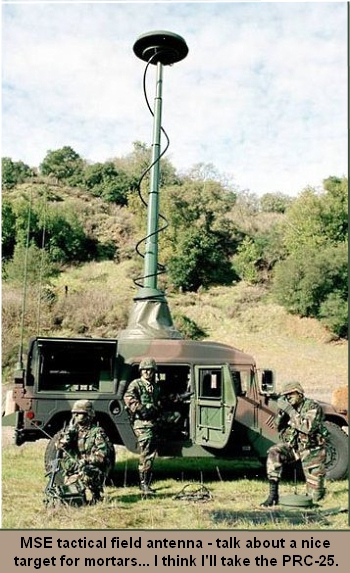
radios they carried no longer required large antennas. For the individual
soldier in the field this meant no more large tape measure like antenna flopping
above his head, calling attention to his location. And of course, no antenna
screaming “here I am” meant fewer shots by the enemy at the watermelon
sitting on the warfighter's shoulders. In case you think this of minor
value, you might note that during the Vietnam War most RTOs (Radio
Telephone Operators) had the shortest life expectancy of anyone in a unit, with most
being killed because the antenna sticking up over their
shoulders provided a precise targeting point for the VC. As important, it
also provided a target point for incoming mortar fire by the VC, as they
knew that a) whoever was leading the squad in the field was close by the
RTO, and b) the rest of the squad was not far away either.
A
few mortar rounds or RPGs placed in the vicinity of the RTO's antenna was sure
to cause major destruction to the unit involved. Considering these facts,
avoiding this problem alone made the MSE system worthwhile, however that was
not the only benefit, by far. Perhaps the greatest benefit was that no
longer was a combat unit or commander restricted to one radio, being carried
by one RTO. Now nearly everyone could have one, and as you will see as we
learn of how the
MSE evolved into the WIN-T system, this concept of equipping every warfighter with his own personal means of communication would just keep
growing.
In the process of all of this happening though, the much beloved PRC-25
disappeared into history. Farewell fine friend.
As the MSE gained ground in the 80s, the hardware
involved soon found its way into every form of transportation the Army used.
By the early 1990s MSE gear was being installed in Humvees. Many MSE
equipped Humvees saw action in operations Desert Shield and Desert Storm.
The 11th Signal Brigade used the idea of installing MSE gear in Humvees so successfully that they were
able to handle data traffic in and out of the combat zones they covered at
rates that averaged 10 million words a day. But good as it was, and
regardless of how well it did the job of replacing the kind of communication
networks available in the Vietnam War, technology’s relentless march
soon made the MSE network just another outdated concept.
By the start of the 21st century a post MSE world was
beginning to take shape. It came in the form of a single enterprise communication
system that in turn was based on an interim communication architecture that
supplemented the MSE system and was called the Land Warfare Network (LandWarNet).
LandWarNet was originally intended to stand on its own
as a communication network, but was later determined to not provide all of
the capabilities that the U.S. Army needed. To overcome its shortcomings and
at the same time upgrade the capabilities originally built into the older
MSE it
was decided to do away with the MSE architecture and hardware and instead integrate the LandWarNet into an
even newer system than both of these. This new system was being designed by the DoD
and was called the Global Information Grid or GIG.
Still a work in process today, as designed, the Global
Information Grid was to connect all information systems and their individual
components and services within the Department of Defense (DoD) into one
unified information system.
To understand how this all fits together the reader should
know that the GIG was not intended to be and is not a standalone system per se;
not like the MSE was. Instead, it is a system of systems. Thus considering
the inflexibility of the underlying technology in the MSE, it had to be done
away with. The LandWarNet on the other hand had the capability of being more
easily networked with other systems, and so it was kept around and integrated into the GIG.
Part of the reason for inventing the GIG
in the first place was recognition that operational concepts such as Joint
Battle Management Command and Control (JBMC2) require an ability to work
across multiple command and control areas, not all of which will be part of
the same communication network. Unless these disparate communication systems
can be integrated so that they work well with each other, operational
concepts like JBMC2 might well fail. Solving this problem was reason enough
to cause the
GIG to come into existence, however, it was not the only problem the GIG was
intended to
solve. The survivability of a standalone system like LandWarNet proved as much
of a problem as the overall network's inability to let everyone talk with
everyone else. Because of this GIG was designed so that its architecture
would embrace other communication systems that heretofore only operated
autonomously.[2]
In this regard, while systems of systems are more
difficult to build and manage because of their simultaneous independence and
interdependence on small, medium and large daughter systems, what they lose
in terms of ease of integration and operation they make up for in terms of
survivability. Traditional stand alone communication systems can be taken
down, and so their survivability measure will fall short of that needed to
win a modern day fast moving battle, never mind defend a nation. To overcome this, the GIG was developed, intending to be a
system of systems that increased the overall survivability of the military’s
communication network at the cost of ease of design, use and integration.
As efforts moved forward to refine LandWarNet and
integrate it into the Global Information Grid it became obvious that more
was needed than what LandWarNet could offer the Army. To overcome
LandWarNet’s shortcomings the field operations portion of something called
the Warfighter Information Network-Tactical, or WIN-T, was looked at as an
alternative. WIN-T soon became the darling of the Army, and in short order
became the de facto replacement for the older Mobile Subscriber Equipment
system. So strong was the Army’s support for WIN-T that its 2008 Army
Posture Statement began disparaging the older MSE system by referring to it
as being “antiquated.” There’s nothing like letting your bias show, is
there?[3]
In a nutshell, as the Army will tell you if you ask, “Warfighter Information Network-Tactical is the Army’s fully mobile, tactical communications network system.
It is designed to provide reliable, secure, and seamless video, data,
imagery, and voice services that enable decisive combat actions. It will
move information in a manner that supports commanders, staff, and functional
units while enabling full and continuous mobility of large formations.
“As the Army’s tactical portion of the Global
Information Grid (GIG) network, WIN-T will enable deployed forces to
collaborate with GIG services and capabilities (databases, collectors, and
national agencies) to increase information-enabled operations. Such
collaboration to date has required various Department of Defense (DoD) and
other governmental agencies to create multiple private networks or deploy
agencies forward. WIN-T was designed not only to replace the mobile
subscriber equipment (MSE), but will also replace the current tactical
intelligence and logistics networks as a single integrated network.
“It will be optimized for offensive and Joint
operations by providing bandwidth on the move through a network that is:
Self-forming. Units moving on the battlefield can
automatically switch communications between WIN-T nodes without massive
configuration changes.
Self-healing. The loss of one element doesn’t
disrupt the network.
Scalable. Support can be easily expanded from a
small task force to a large formation.
Interoperable. The system is fully interoperable with current Army and Joint
Forces.”[4]
Like civilian systems such as the Web and corporate
intranets, the WIN-T system relies on Internet Protocol (IP) technology and
draws significantly on commercial products and services, including the
Iridium satellite network. Depending on the military’s needs, as designed,
WIN-T can be integrated with both 3G and 4G wireless technologies, thus
bringing all of the advantages of smart phones to the field of combat.
Primarily an effort of General Dynamics and Lockheed
Martin, if the Army is to be believed WIN-T is the be all to end all.
This rapid change in military communication technology
makes one wonder, what's next?
Imagine the future… infantry soldiers advancing with their heads down, not
to avoid incoming bullets, but because their eyes are glued to their touch
screen as they Tweet home to Mom “omg, im under fire… wtf?"
As for the equipment we grew up with... our lowly
PRC-25 is now no more than a dusty piece of equipment with batteries that
long ago stopped working. If you look hard enough you may be able to find
one or two sitting as curiosity pieces in museums devoted to ancient wars,
in places where they will never again see the light of day, hear the slap of rotors from above, or feel the heat of napalm as it
rolls across your forward position. Like those
who carried it on their backs or barked orders through its Bakelite handset,
the PRC-25 is over the hill, long past its use-by date, and far beyond the age of
retirement.
We will miss you, fine friend.
Footnotes
[1] Click
here to read a whitepaper entitled: Integration of Commercial Routing
with Flood Search Routing, Christopher B. Duncombe, GTE Government
Systems. The paper discusses the integration of the Army’s tactical MSE
communication system with Code Division Multiple Access (CDM) digital PCS
systems.
- To return to your place in the text click here:
[2] Global Information Grid Survivability: Four Studies;
Richard C. Ciampa, Dawn Day, Jennifer R. Franks, Christopher T. Tsuboi,
March 2007. To read the full study click here:- To return to your place in the text click here:
[3] Information Papers - Transform;
Warfighter Information Network–Tactical; What Is It? To read the full
white paper click here: - To return to your place in the text click here:
[4] Ibidem.- To return to your place in the text click here:
Additional Sources
AN/PRC-25 - A Forgotten Legend;
by Dennis Starks, as reproduced from an article in the "Military Collector
Group Post," an international eMail magazine dedicated to the preservation
of history and the equipment that made it. Read the full article here:
Overview of the latest status of WIN-T; called Increment 2 this short
article explains how WIN-T Increment 1 provided battalion level and above
warfighters with the ability to connect on the move to all of the Army's
digitized systems (voice, data, video and satellite). Among the advantages
this brought was an ability for a soldier to receive real time updates of
where his buddies were on the field. Increment 2 will provide full duplex
two-way communication, on the move. Read more here:
For
the geeks in all of us, click on the cover at right to read your very own
copy of the DoD's Field Manual on the operation of the MSE system.
Like this article? Let us know by
helping us with our scholarship fund efforts. A $30.00 donation
to our
Scholarship Fund
will help us get one step closer to helping another deserving High School
graduate attend college. Your donation is tax deductible and your
kindness will go father than you think in making
it possible for another young American to fulfill their dream of a college
education. Thank You!
Original Site Design and Construction
By John Hart, Class 07-66. Ongoing site design and maintenance
courtesy Class 09-67.
Content and design Copyright
1998 - 2013 by ArmySignalOCS.com.







 Part
of the answer lies in the fact that although the war ended, advancements in
technology did not.
Part
of the answer lies in the fact that although the war ended, advancements in
technology did not.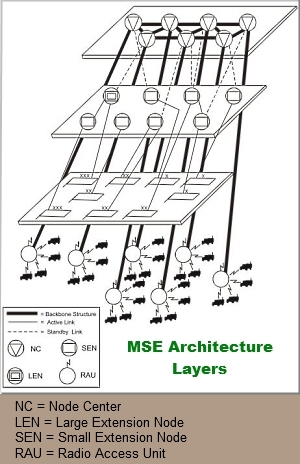 The
network itself, depending on how many switching centers were employed, was
able to cover a battle space of about 15,000 square miles. Within that space
those connected to the switching centers were treated as subscribers. From a
technology standpoint, it did not matter whether subscribers were connected
to the switching centers by radio or by wire, just as long as they were
connected.
The
network itself, depending on how many switching centers were employed, was
able to cover a battle space of about 15,000 square miles. Within that space
those connected to the switching centers were treated as subscribers. From a
technology standpoint, it did not matter whether subscribers were connected
to the switching centers by radio or by wire, just as long as they were
connected. A
few mortar rounds or RPGs placed in the vicinity of the RTO's antenna was sure
to cause major destruction to the unit involved. Considering these facts,
avoiding this problem alone made the MSE system worthwhile, however that was
not the only benefit, by far. Perhaps the greatest benefit was that no
longer was a combat unit or commander restricted to one radio, being carried
by one RTO. Now nearly everyone could have one, and as you will see as we
learn of how the
MSE evolved into the WIN-T system, this concept of equipping every warfighter with his own personal means of communication would just keep
growing.
A
few mortar rounds or RPGs placed in the vicinity of the RTO's antenna was sure
to cause major destruction to the unit involved. Considering these facts,
avoiding this problem alone made the MSE system worthwhile, however that was
not the only benefit, by far. Perhaps the greatest benefit was that no
longer was a combat unit or commander restricted to one radio, being carried
by one RTO. Now nearly everyone could have one, and as you will see as we
learn of how the
MSE evolved into the WIN-T system, this concept of equipping every warfighter with his own personal means of communication would just keep
growing.