Play our music game. See if you can find the hidden
Army marches on our site. Click the icons you find on each page. Some have music
hidden
behind them, others do not. Good luck!
Music courtesy USAREUR Band
To follow us on Twitter, click here!
Click below to LIKE us!
Click below to check out our Facebook page.
Make a difference!
It’s easy to give!
As a non-profit organization
donations to our Scholarship Fund are 100% tax-deductible.
More importantly, your donation helps children of
Signal OCS families achieve their dream of a college education.
Contributions in any amount are welcome.
Just click on the
DONATE button above to make a donation today.
Thank You!
From Our Home Page Archive:
Home Page as originally published in
July 2013
— This Month —
1.
The Signal Corps Between The Wars – How
the Signal Corps may have singlehandedly changed the outcome
of WWII and made America a Superpower.
And...
2.
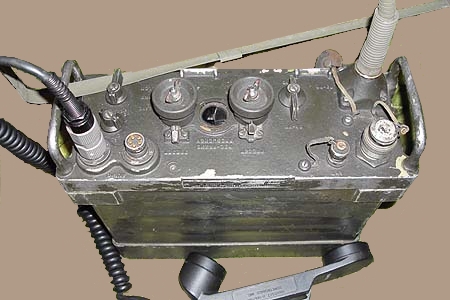
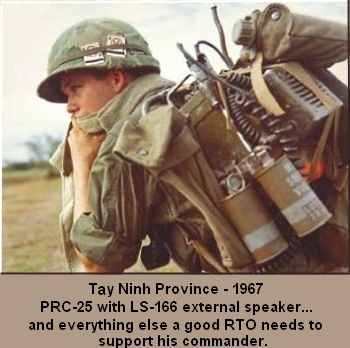
What happened to the PRC-25?
- - - - -
Join us over the next 3 months for a follow
up to our first article above, as we explore how the Signal
Corps turned wire, radio telephony and radar to America's
advantage. In August we'll explore the role wire played in
WWII. In September we'll look at radio telephony, and in
October we'll study the impact of radar. Please, join us then.
MISSION STATEMENT
Our Association is a
not-for-profit fraternal organization. It's purpose is a) to foster
camaraderie among the graduates of Signal Corps Officer Candidate
School classes of the World War II, Korean War, and Vietnam War
eras, b) to organize and offer scholarships and other assistance for
the families of Officer and Enlisted OCS cadre who are in need, and
c) to archive for posterity the stories and history of all of the
Signal Corps OCS Officers who served this great country. We are open
to ALL former Army Signal Corps OCS graduates,
their families and
friends, as well as other officers, enlisted men, those interested
in military history, and the general public.
Please, come join us. For more information about our Association, to
see a list of our Officers and Directors, or for contact details,
click on the OCS Association link at left.
Please note: The
views and opinions expressed on this website are offered in order to
stimulate interest in those who visit it. They are solely the views
and expressions of the authors and/or contributors to this website
and do not necessarily represent the views of the Army Signal Corps
Officer Candidate School Association, its Officers, Directors,
members, volunteers, staff, or any other party associated with the
Association.
If you have any suggestions for improvements to this site,
please send them to
WebMaster@ArmySignalOCS.com. We are here to serve you.
What Happened To The
PRC-25?
Who can forget the PRC-25. It was as
ubiquitous in Vietnam as Donut Dollies were few and far
between, or as “short times” were for 375 “Pi.” What
happened to it… the prick-25 that is?[1]
A transistorized FM radio transmitter that operated on 920
channels, the PRC-25 had a realistic range of 3 to 5 miles
sitting there by your side... which was good enough to get
most of your needs done. But if you were lucky enough, the
range could be boosted to cover the whole country with the
help of a kluged helicopter or spotter plane with relay
transmitters built into them. The 1st Cavalry Division's
13th Signal Battalion pioneered this approach, and made good
use of it by circling spotter planes and Hueys above ground
units in the boonies, retransmitting the intercepted FM
signals over distances as great as 60 miles so that the guys
in the field could talk to HQ back in Nha Trang, or
wherever. With this simple expedient, the average Company
Commander in the field was able to stay in touch with almost
anyone he could possibly need to talk to from rear fire base
Arty boys to the big guy himself, Gen. Creighton Abrams,
head of Military Assistance Command in Vietnam. So important
was the PRC-25 to the war that Abrams himself branded it
"the single most important tactical item in Vietnam."
More than just a radio transmitter, the PRC-25 was a friend.
It was tough, and it’s toughness made you feel that much
tougher. The thing could easily survive a 50 foot fall from
a chopper onto a PSP planked runway... imagine doing that
with your AR-15. If you came under fire while crossing a
rice paddy, you could rip the thing off your back and drop
it in the water for an hour or so, completely submerged, and
it would still work when you pulled it out. When you did
that though, you had better not drop the handset in the
water too, because if you did you were S-O-L. The radio,
o.k. The handset, nope… never. Keep it dry or suffer the
consequences.
Weighing a little over 23 pounds, the damned thing was the
closest thing to a girlfriend anybody in Vietnam ever had.
If you had a chance, you would sleep with it every night.
So what happened to the PRC-25?
America Between The Wars
- - - - -
It’s always enjoyable to read the
stories and exploits of the men who fought WWII; and if not
their personal stories, the stories of how that war was
fought. One of the reasons for this is that the war was won.
Unmistakably won. Unlike so many of America’s recent wars
where either the reason for the war, the outcome, or the
result has done little more than raise tons of questions as
to what the whole exercise was all about, with WWII there is
no doubt as to why the war was fought, what the outcome was,
or what happened to all of the countries involved once the
war was over.
On all fronts, from the reason as to
why WWII was fought, to what happened to the countries that
lost, reading of WWII brings a sense of accord and
satisfaction to almost all who study this war. As a war,
most of the countries that participated fought it with true
integrity, the result of which is that today their reflected
glory falls on many around the world, save those despicable
rulers and commanders whose perfidy, cruelty, lack of humanity or absence
of principles led to war crimes and transgressions against
humanity. Still, if one sets aside the action of these
people, the sadness of death and the many senseless losses
that occur in war, not to mention the deceit of torture such
as that suffered by scores, and too the numbing pain that
comes to innocents who find themselves caught up in war, one
can see WWII as a bright star amidst the burning embers of
destruction.
How
did this happen? How does it come to pass that a war… any
war… can happen, where when it is over the world sighs with
relief not just that it has ended, but for the fact that the
better part of the world did the right thing in not just
fighting it, but also managing how they fought it, and how,
as victors, they handled the losers when the war was over?
Part of the answer lies in the means
by which nations come to recognize that layered on top of an
obligation to manage their own country wisely is one that
says that they have obligations to help the world at large
too. In this regard, how a country manages its global
obligations towards war goes to the heart of its ability to
do good or evil when fighting that war.
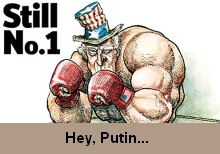
One can see this in the U.S. today,
especially when one considers the criticism we have come
under for sticking our nose in everyone else's
business.... or at least that's what Vladimir Putin thinks.
'Vlad the shirtless wonder' has been
proclaiming to all who will listen that America is "collapsing under the burden of
its global interests." His point is that America no longer
knows what to do, where to do it, when to do it, or how to
do it... and so needs to back off and put its own house in
order rather than continue telling the world what to do. He says
America's involvement has brought little benefit to the world.
When asked, he offers his opinion that America is failing because it elects populist Presidents, instead of
competent ones. He says that the media narcissists in our
government, those who are constantly seeking attention and put their image and power above that
of the country and people, have made America a third rate
country that, while it may still have some power, is loosing
it quickly. In Putin's mind, America is a misdirected, self
centered, clumsy giant who is getting its due for having
stuck its nose into the business of too many other countries.
One need not ask what China thinks.
Regardless
of whether you agree with Putin or not, his views do raise
some important questions. Does a country like America
have an obligation to help the world, or does it not? If
not, then why did we join in the war against Germany? If so,
then how does one decide which countries to help and which
to avoid... or more to the point, which wars to fight and which to
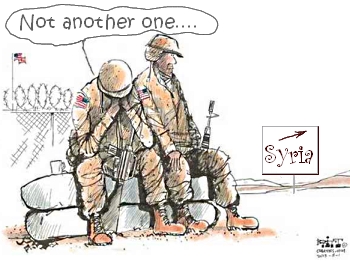
avoid? Is Syria one we should involve ourselves in?
And if a country decides to fight a
war—be it today's Syria or yesterday's WWII Germany—what
factors determine whether a country’s efforts will cause it to fight an
effective war… effective from the standpoint that the
war is fought for the right reasons, in the right way, with the right degree of concern for humanity,
and in a manner so that the war is won?
For many of these questions, it is
hard to know the answers. With this last question however,
we think we know what the answer is. The answer is that three elements
combine to determine the outcome of any war a powerful
country decides to fight, especially a country that is a Superpower: 1)
the basic principles that the people of that country believe
in, 2) the willingness of the people of that country to send
its manpower to help better the world, and 3) the
willingness of the country’s governing body to prepare in
advance of any future war those materials that will be
required to assure a successful outcome... for without
preparation there will be no successful outcome, and without a
successful outcome the two previous points will prove of
little value.
Let us look at these individually, and
both see if we can learn some lessons and at the same time
gain a hint about the unique job the Signal Corps did
between WWI and WWII in not only preparing American for WWII, but preparing America for its rightful place in
the club of nations that would inhabit the world when that
war was over.
Principles
Item 1: The basic principles that the people of a country believe
in.
With regard to the basic principles
that the people of a country believe in, being a military
website, while we would love to offer our views on this
topic, we feel it only proper that we pass here on evaluating the values,
philosophy, morality, and ethics that pulse through
America’s veins. The simple fact is, while we have some
modicum of expertise when it comes to the subject of the
military and war, we are poorly qualified to offer anything
other than opinion on what makes one country’s value system
better than any other’s. And in that regard, our opinion is
no better than anyone else's. Even so, we can't resist the
temptation to say here that if one were to look at
America’s value system today, especially if done with some
degree of scrutiny, they would likely
see that while most elements of America's value system are noble,
many of the better ones are under attack from ideologues and
political hacks whose personal agendas override those of the
American republic at large.
Be that the case, as arm-chair
military historians not qualified to analyze whether
America’s principles are in need of burnishing or not… we
will pass here on the temptation to do so.
Manpower
Item 2:
The willingness of the people of a country to send its
manpower to help better the world.
As to America’s willingness to send
its manpower to help better the world, an analysis of this
topic would be a non-discussion, as of all of the countries
of the world everyone on earth knows that America is the
first and the fastest to come to the aid of others. Or so it
has been until we seemed to have forgotten how to care for
our own in Benghazi, seem today to not be aware that tens of
thousand of innocents are dying in Syria for lack of a
strong resolve on America’s part to stand toe to toe against
Russia and Iran, seem not to care that warlords are wielding
crimes against humanity across the world, such as in Mali in
Africa, or seem the least concerned that America's current
administration has embarked on an isolationist,
non-interventionist foreign policy that rivals that of
Woodrow Wilson.
Notwithstanding this,
the basic fact is that while the government we have today
may not be inclined to broaden America’s involvement in many
of the crises that face the world, Americans on the whole
are a caring and generous people and generally willing to
send their sons and daughters to help better the world, even
at risk to their own family’s quietude.
From this standpoint then, with regard
to the resolve of the people of America to help those of the
world who need our help, the fact stands for itself: America is prepared to do
more than its part to help those in need. On this issue,
America leads
the world.
Preparing for War
Item 3:
The willingness of a country’s governing body to prepare in
advance of any future war those materials that will be
required to assure a successful outcome.
Why just materials? Why not manpower
too?
In many ways, the preparation of
manpower to fight a new war can be done with some alacrity
at the time a war commences. That is to say, when it comes
to manpower, what is needed is more in the nature of a
highly skilled core of men in the form of a modest sized
standing army than a massive army of size sufficient to
win a new war. Or put another way, if the right level of
competence is maintained in a correctly sized standing army,
whatever the size of the larger fighting force that is
needed when war commences can by and large be built at that time. That is
not the case however with war materials. If you don't
prepare the war materials you need in advance of a war, those
materials won't be there when they are needed. And while
this can be a problem in terms of things like guns and
bullets, it is an even greater problem if the level of
technology being prepared for use in the next war does not
keep pace with advancements in the technology itself right
up to the start of and through the early stages of a war.
It's on this latter point that America
stands apart today from other countries. What few of our
readers will suspect however is that America began this
tradition of not just using applied science to prepare for
the next war, but of turning emerging technologies into
applied science as a means to develop even more advanced
forms of military hardware, between WWI and WWII.
Yes, amazingly, between these two wars
America's military got about the task of trying to figure
out how to truly leapfrog the rest of the world's war
fighting capability by using emerging technologies to
develop newer forms of armament
than anything theretofore available—and it was the Signal
Corps that set this precedent and led that effort.
In those early days the Signal Corps
showed an
uncanny ability to prepare the entire U.S. military for the needs of
the next
war, even prior to the onset of that war. We ask the question
then, how is it that the Signal Corps was able to foretell
future strategic and tactical needs and work to
prepare military materials to meet those needs, even before
the needs occurred?
We
can find the answer to this if we take a retrospective look at the
trials, travails, successes and failures the Signal Corps
had in the period between WWI and WWII.
As most know by now, the U.S. government's normal reaction at the end of every war is
a kneejerk one based on cutting back on
military spending, downsizing the military, letting go the very
cream of our fighting crop—presumably on the assumption that their warfighting skills and experience will
by no means ever be needed
again—and otherwise acting
like war is a thing of the past that no country will ever
revert to. Or so they act, until some malfeasant
country takes it on itself to tweak America’s nose, at which
time they then panic that they laid off the entire military and set
all of its equipment to rust. At the end of WWI that’s just what
happened. The U.S. Military was decimated beyond all
measure.
This page last updated 1 July 2013.
New content is constantly being added. Please check back
frequently.
Posted 1 July 2013
–Details for the 2013 Army Signal
Corps OCS Reunion are available. Click on the
Reunion Info link above left
to read them. It's being held in Augusta, Georgia. Sign up now and be sure to join us there!
Posted 1 June 2013
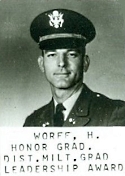
–New class picture for Class
01-67, courtesy of Herb Worff, has been posted. Be sure to
check it out on the 01-67 Class Page. Thanks
Herb, it's sure strange to see how young we all looked back
then, including you!
Posted 11 May 2013
–Candidate Don Mehl, OCS Class
44-35, sent us a
great reunion booklet from his old unit, the 805th Signal
Service Company. Filled with 13 pages of pictures and
historical information on the unit, it lists many, many
Signal OCS graduates that went through Monmouth's program
and served in the 805th. Take a look at it by going to our
reunion page, scrolling down
the page, and clicking on the picture of the 805th booklet there.
Continued from left column...
However,
what
the Signal Corps also knew back then about this kind of "downsizing" was that—as
we said earlier—while manpower requirements for a “next
war” can (for the most part) be put on hold until the event
occurs, that is not the case with respect to the materials
needed to fight a future war—nor for that matter the
technological systems that make war fighting possible.
Because of this, forward thinking planners like Major
General George Owen Squier, Chief Signal Officer at the end
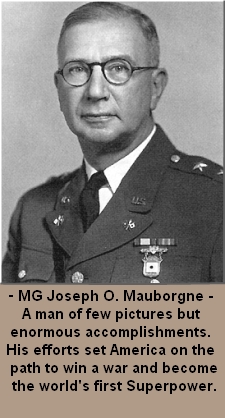
of WWI, and especially Major General Joseph Mauborgne (1881
- 1971), the Chief Signal Officer that presided over the
Signal Corps between WWI and WWII, set in motion plans to
assemble and prepare the kinds and types of warfighting
equipment and systems that would be needed when and if a
“WWII” ever broke out. Considering that the world at that
time felt that the suffering experienced in WWI was so great
that the world had learned its lesson and would never again
go to war, the resolve of these two Generals to think that
rather than sit back and relax they had better get about
preparing for the next world war, was quite something.[2]
More than just making plans to accumulate material to
support the men, these Generals set about assuring that the
Signal Corps worked hard to make better the types of
materials and systems that would be available when and if
another war came. More to the point, they went about this
task with a sense of haste. Not haste as in panic, mind you,
but as in ‘with a purposeful sense of urgency.’ In other
words, under their leadership the Signal Corps took the
attitude at the close of WWI that its task was not to sit
back and enjoy having won the war, but get busy preparing
for the next one, just as though it was surely just
over the horizon.
In this regard, what set America apart from the early 1920s
up until 1939 in terms of getting its house in order for the
next war was the recognition on the part of the Signal Corps
that preparing for war is as much a part of the art of war
as fighting it is. When one considers that the Signal Corps
is a branch whose general purpose is to serve the needs of
other branches, and was clearly so back then, the importance
of this attitude cannot be over emphasized. The fact that
the Signal Corps anticipated the needs of the branches it
served at that time and worked diligently between the wars
to mentor those branches in terms of how technology could be
brought to bear to improve their war fighting capabilities,
and to make that technology available to them, is
astonishing. In the late 1930s the men of the Signal Corps
were world class thinkers, standing far in front of their
peers. Almost singlehandedly, what the Signal Corps did was
assure that when the next war came the sister branches it
supported would be prepared for it… if not in training or
manpower allocation, at least with respect to the equipment
needed and the systems required to support better combat
capabilities, armament, command,
and control.
The secret to the Signal Corps’ success in doing this was
that they met this dual task of developing more effective
war fighting hardware, and integrating it into an improved
command and control system, by using a three step approach:
First they mounted an aggressive research effort to find out
the limits of what could and could not be done with the
technology at hand and the state of science as it then
stood.
Then they took the output of this research and used it to
modify and improve the performance of off the shelf public
market products… products which on their own might fall
short of military needs but were nevertheless close enough
in capabilities and performance so that concentrated
engineering design changes might result in a truly
breakthrough piece of war fighting equipment.
Finally, they only did this in those cases where effective
command and control systems could be built up around the
hardware to assure that the maximum benefit attainable out
of the new technology or armament could be gained by those
in the field.
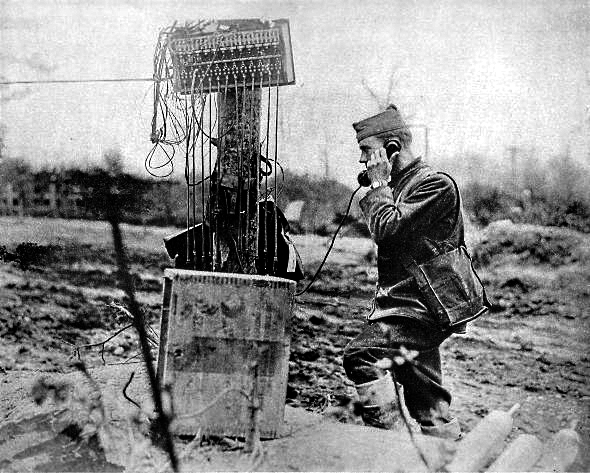
A simple process, when one considers that the Signal Corps
did all of this between the wars, without computers, in an
analog capacity, when no one else cared, on a severely
limited budget, and simply by dint of determination… well,
it is astounding what was able to be done.
The reader should understand that this was not simply an
exercise in sourcing and inventorying as many pieces of the
equipment and systems that worked during WWI as possible,
and storing them for the next war. This was an exercise in
replacing WWI’s command and control systems, and in many
cases armament too, with a form and type of technology that
had yet to come to the world. It was an exercise in
revolutionizing how America would fight its wars, the core
technology that was used, and the hardware it would fight
them with. On a macro level, what is clear now is that the
Signal Corps set out in the 1930s to research what each and
every service branch it supported might need in the next
war, and get busy producing those systems so that its sister
branches would be just as successful in the next war as they
had been in the last.
Sitting here in the 21st Century it is
easy to think that the Signal Corps was doing little more
than it was supposed to do. But that is not the case. At
that time the Signal Corps did not have a mandate to develop
systems that pushed the bounds of war-fighting strategy.
During the First World War the U.S. had a "National Army."
This Army was specifically organized to fight WWI, and
little more. Once the war was over, it was demobilized and
was replaced by three new elements: the Regular Army, the
Organized Reserve Corps and the “State Militias” (more
correctly, Organized Reserves). Within this context
war-fighting strategy was most definitely not set by the
Signal Corps, nor was selection of the hardware and armament
systems to be introduced into the strategic makeup of how
wars were to be fought. It was the purview of the then
called War Department. Yet the Generals in charge of the
Signal Corps, seeing that little strategic thinking was
being exercised in the War Department, stepped up to the
plate and took their turn at bat. [3]
Some Dead Myths Are More Alive Than Others. Some Are Also
More True.
It’s interesting to watch what is happening in Turkey and
Brazil. Is
there an enemy coming over the fence here, or is something
else going on?
In both Turkey and Brazil's case, is it possible that
the people are fighting back vehemently because of what they
perceive as a dismissive attitude on the part of their
government towards the needs and will of the people, coupled
with an overtly heavy handed response with water cannon and
tear gas far exceeding what was needed to bring peace to the
streets, all topped off with more government arrogance than
the average citizen can stand?
In Turkey's case, is what is going on a simple protest over
the turning of a city park into a Moslem focused business complex? Or is
the source of the anger really more a matter of frustration
that the newly elected president seems to be an avowed
Islamist hell bent on bringing Islamic laws to a secular
state? Or is the protest the result of
the slow seep and spread of Islamic fundamentalism into
Turkey, from places like Iran, Iraq, Syria, Libya,
Palestine, Afghanistan, Pakistan, Egypt, and the UAE? Is the
mostly secular state of Turkey going fundamentalist? Is the
domino theory at work here?
Looking at Turkey, it's hard to know what is causing the fracture, but if
it's fundamentalist inspired it does remind one of the
domino theory. Remember that ruse? Or was it a ruse? Was
the domino theory real, or just a product of someone’s
imagination?
From our perspective sitting here on the safe side of this
50 caliber, our view is that the common belief that the
domino theory was proved false is itself false. The domino
theory was real. The war in Vietnam stopped the domino
theory from coming true. It stopped it cold in its tracks.
Don't agree with us? Then consider this...
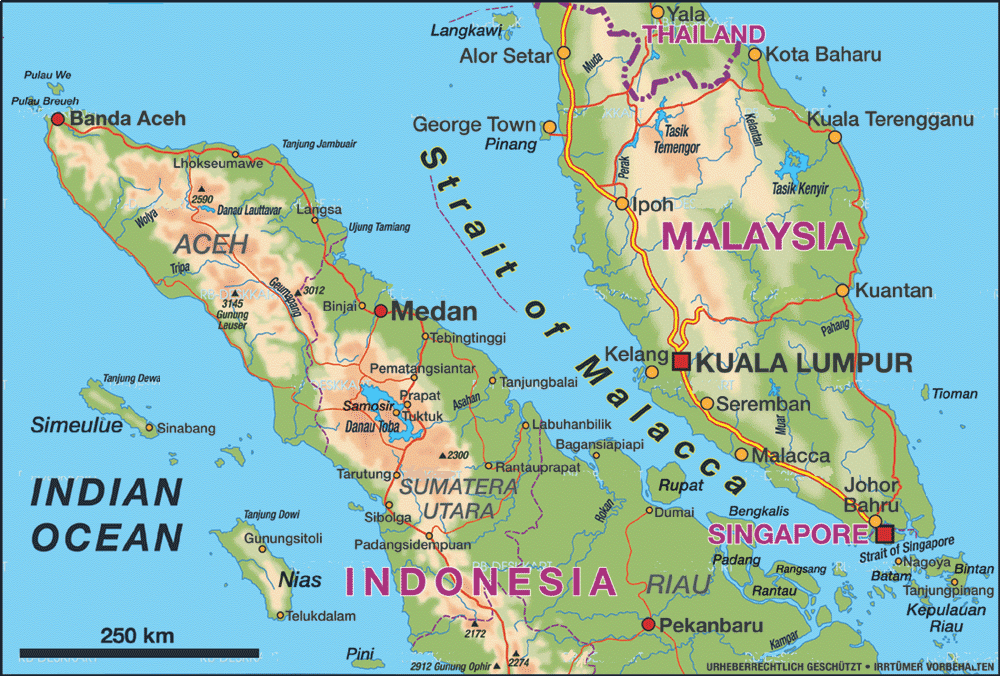
The ASEAN (Association of Southeast Asian Nations) countries
(Philippines, Indonesia , Malaysia , Singapore , and
Thailand) all credit the Vietnam War with helping them to
stay free of Communism. They make no bones about it.
According to these countries the U.S.’ commitment to Vietnam
was the reason that their own fight
in the 60s - 70s
against indigenous guerillas was successful. At that time
they were fighting to keep their form of government in
place, mostly against China sponsored Marxist groups trying
to destabilize the countryside and overthrow the
governments. What helped the ASEAN countries win against the
guerillas was the fact that those who the insurgents looked
to for supplies and comfort had their hands full with
America in Vietnam, and so were unable to help the guerillas except in the
most rudimentary of ways.
The
result: on a proportional basis few if any recruits were won over by the guerillas,
little in the way of weapons made it into their hands, and
even less ammunition... all of which caused them to suffer a
sustained inability to organize anything more than a few
hamlets and villages in each country they targeted. One
example of this can be seen in the Philippines, where because
of the fact that Ho Chi Minh had his hands full with the
Vietnam War he was unable to help the
Moro Guerillas when they came knocking, hat in hand, to
ask for help in forming an insurrection in the Mindanao
area.
The same was true with Mao Zedong, who wanted to destabilize
Thailand. If Uncle Sam wasn’t marching U.S.
soldiers across the ground of South Vietnam with impunity,
thus demonstrating not only how committed America was to stopping
the spread of communism in South East Asia but also how
powerful the U.S. military was, Mao might have been willing to up the ante and step in to try
to destabilize Thailand. The fact that Uncle Sam was not
truly committed to helping the South Vietnamese succeed in
their effort to own their own country and master their own
destiny aside, Mao believed America was and that was enough.
Even
more dramatically, because of the Vietnam War the
Indonesians threw the Soviets out in 1966. They saw
America’s commitment in Vietnam as a sign of determination
to support them too in times of strife. Without America
touting that sense of
commitment to all of the players of Southeast Asia, Communism
would have flowed out of China all the way down to the
Malacca Strait, a strategic passageway south of Singapore
that held enormous importance for the free world back then,
as it still does today. Whether through Thailand, Malaysia,
Singapore, or Indonesia, if the Malacca Strait fell
within the sphere of China, or as was the worry back then…
Russia… the world could kiss the idea of an integrated global
economy goodbye, along with the freedom and GDP that goes along with it.
So what can we learn from this? If you ask those who live in
these countries today whether the domino theory was real or a
myth, they will tell you it was real. Strangely, their
opinion is different from that of both the American news media
and America's elite, both back then and even today. In the minds
of those who live in Southeast Asia the Vietnam War was
the turning point for Communism. One can say then that regardless of
the outcome of the Vietnam War, those who live in the
countries that surround Vietnam believe that the Vietnam War effort stopped the spread
of Communism in South East Asia and turned the tide forever.
Seen from this perspective… if the Vietnam War was the
battle, we may have lost the battle but won the war.
The Ideal Republic
Did America ever have a President
from Nebraska?
The answer is no, but almost.
His name was Williams Jennings Bryan.
Bryan, a man whose own Democratic
Party was against his nomination, and actually went so far
as to form another branch of the Democratic Party called the
Gold-Democrats to oppose him, was an unlikely candidate for
President. With all on his own team against him, and the
Republicans too, he was left to his own devices to figure
out a way to try to win the election of 1896. What he came
up with was novel and effective: he brought his message to
the people by speaking around the country, often from the
backs of railroad cars. In 1896 this was a new tactic, since
presidential candidates traditionally stayed home and let
others speak on their behalf. It won Bryan both criticism
and fame, but not the election.
A devout Christian, a supporter of
popular democracy, an enemy of the gold standard as well
as banks and railroads, an anti-imperialist, a rabid
supporter of trust busting, and anti-elitist who
nevertheless supported ideals of republicanism, seen from
today’s perspective Bryan would look today like he was about
65% Democratic, 35% Republican, and 100% idealist. Strong
willed with a mind of his own, he seemed to have his hands
in nearly every important event of his era. For example, he
resigned in protest from the position of Secretary of State
because of President Wilson’s strong demands on Germany
after the Lusitania was torpedoed (1915). He also made a
name for himself as a strong supporter of Prohibition, not
to mention his virulent attacks on Darwinism and evolution.
This latter point he drove home famously at the
Scopes
Trial in 1925.
Our interest in him here has to do
with his oratory. As a bit of a radical but nevertheless a true patriot, Bryan spoke well and
eloquently about the America he loved, and while his views
on matters of the time may seem strange from today’s
perspective, his views on what made America great still ring
true. This 4th of July it would do us well to listen to what
he tells us about the wonderful country we live in.
God Bless America.
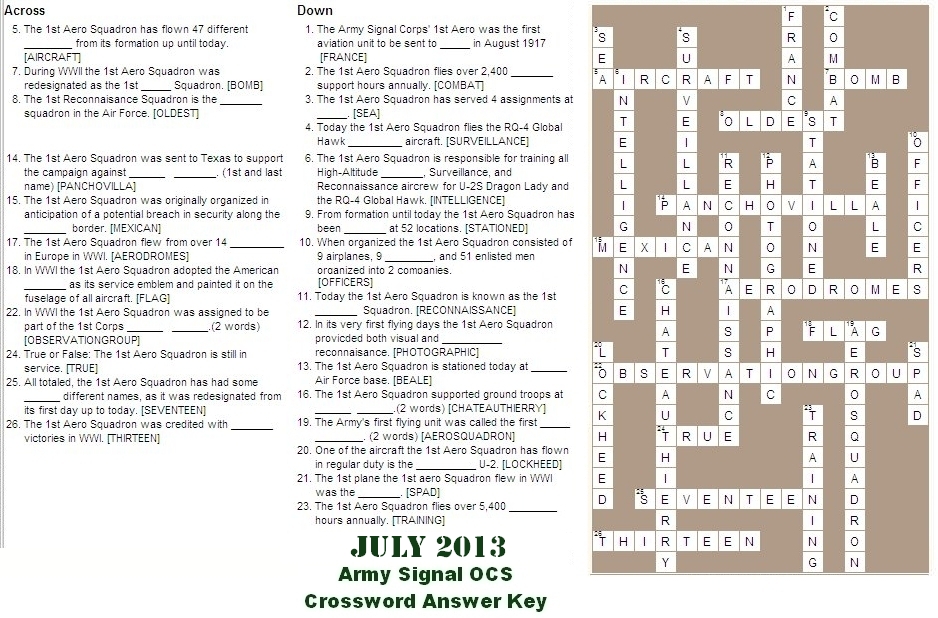
July's Crossword Puzzle
Theme:
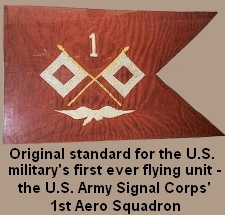
1st Aero Squadron
Click the flag to jump to a fascinating Wikipedia article on
the history of this unit. While the Air Force may try to lay
claim
to it's glory, we know the answer to the question 'Who's
your
daddy?' don't we? One look at the Signal Flag above will
tell
you the answer.
Hint:
Join 2 and 3 word answers together as one complete word.
For
answer key to this month's puzzle,
see icon at bottom of page
Footnotes:
[1]Pi =
Piasters, the currency of South Vietnam, usually exchanged
at the rate of 125 Pi per 1 MPC. If you have to ask what
“short times” means, and why it only cost about $3.00, then
you probably shouldn’t know. - To return to your place in
the text click here:
[2]A brief
overview of some of the key players in Signal History
between the wars:
— When President Wilson ordered U.S. troops mobilized in the
1916 preparations for World War I, Chief Signal Officer BG
George P. Scriven, with almost 40 years of service, was
nearing the mandatory retirement age of 64. Still a vigorous
man, Scriven's twenty-two years in the Signal Corps included
acting as Chief Signal Officer of the American force in the
China Relief Expedition (1900). Advances in communications
technology picked up momentum as Scriven physically expanded
the Signal Corps. The word radio appeared for the
first time in the American press. Heretofore, it was called
wireless. The telephone was a proven communications
device, but a 1916 long distance demonstration astounded the
Army's Chief of Staff General Scott when he talked directly
to General Pershing in Texas. World War I proved to be a
turning point for the Signal Corps. It changed from a small
band of individual experimenters into a large corporate
organization, owing largely to the influx of civilians from
the commercial communications industry. Fortunately for the
Corps, Scriven sent LTC George O. Squier, as military
attaché, to London where he observed Allied technology and
prepared to replace Scriven as the first head of the Signal
Corps with an earned Ph.D. in applied science. To jump to
another website and read more about BG Scriven Link click
here:
— Major General George Owen Squier, Chief Signal Officer
during WWI. As executive officer to the Chief Signal
Officer, U.S. Signal Corps in 1907, Squier rescued an
essentially well meaning but unprepared Scriven from failure
by driviung the Signal Corps to acquire the technologies and
capabilities needed to support a successful WWI fighting
effort. He was instrumental in the establishment of the
Aeronautical Division, U.S. Signal Corps, the first
organizational ancestor of the US Air Force. He also was the
first military passenger in an airplane on September 12,
1908, and working with the Wright Brothers was responsible
for the purchase of the first airplanes by the US Army in
1909. From May 1916 to February 1917 he was Chief of the
Aviation Section, U.S. Signal Corps, the first successor of
the Aeronautical Division, before being promoted to major
general and appointed Chief Signal Officer during World War
I. In 1922 he created Wired Radio, a service that piped
music to businesses and subscribers over wires. Liking how
'Kodak' was a made up name, in 1934, he decided later to
change the service's name to 'Muzak'. Today, every time you
step into an elevator and hear music you can thank the
Signal Corps. To jump to another website and read more about
BG quier click here:
— Major General Joseph Oswald Mauborgne; from October 1937
to his retirement in 1941 was the Army's 12th Chief Signal
Officer, in command of the Signal Corps. Among the more
interesting things about his career is that he received his
promotional stars from his predecessor. He in turn passed
them on to his successor, and so it has continued down until
today where the Chief Signal Officer wears the same stars MG
Mauborgne, and every prior commander, wore. Of more
importance perhaps, MG Mauborgne did the most of all modern
day Chief Signal Officers to prepare the Signal Corps for
what lay ahead, and to him much of the success of the
systemic and logistical efforts of WWII belong. One of the
more important causes he championed had to do with
cryptography. Among his pets was the challenge of defining a
One Time Pad for use in encryption and decription. The
idea of the One Time Pad was to extend Vigenère's cipher so
that the key used was as long as the plaintext message. This
would mean that there would be no repeat in the key
sequence, which in turn would mean that the code could not
be broken by finding the key length + frequency analysis.
Under a situation like this the key would have to be a
random string that was at least as long as the plaintext
itself. For those geeks among you who actually understand
cryptography, click on this icon
to download and read from our website a PDF file on this
topic. For more information on BG Mauborgne himself
and his exceptional lfe, please click here
For those of
our readers who are rabid intellectuals and interested in
cryptology, and who wonder how the whole thing got started
in America, you may want to download and read the following
file about the establishment of the NSA. The file deals with
the quest for cryptologic centralization and the subsequent
establishment of the NSA. It covers the period 1940 –1952,
and was published in 2005 by none other than the National
Security Agency itself
- To return to your place in
the text click here:
[3]
"The National Defense Act of June 4, 1920, governed
the organization and regulation of the Army until 1950 as
one of the most constructive pieces of military legislation
ever adopted in the United States. It rejected the theory of
an expansible Regular Army that Army leaders had urged since
the days of John C. Calhoun. In its place the new defense
act established the Army of the United States as an
organization of three components: the standing Regular Army,
the National Guard, and the Organized Reserves. That
component consisted of the Officers’ Reserve Corps and the
Enlisted Reserve Corps, two distinct organizations. Each of
the three Army components was to be so regulated in
peacetime that it could contribute its appropriate share of
troops in a war emergency." Source: Chapter 2, Pg. 57,
Between World Wars, American Military History, Volume II.- To return to your place in
the text click here:
Search Instructions:
To perform a
quick search for a VIETNAM, KOREA or WWII era class (such
as: 7-66),
a graduate (such as: Green), or a site search, follow
this example:
A search, for example, for Richard
Green, will result in all the "Richard" entries,
all the "Green" entries, and all the "Richard Green"
entries.
Original Site Design and Construction
By John Hart, Class 07-66. Ongoing site design and
maintenance courtesy Class 09-67.
Content and design Copyright 1998 -
2013, ArmySignalOCS.com
This site is updated as we
receive new material. Please check back frequently. For your
security, please read our Website Privacy & Use Policy by
clickinghere.









 Regardless
of whether you agree with Putin or not, his views do raise
some important questions.
Regardless
of whether you agree with Putin or not, his views do raise
some important questions. 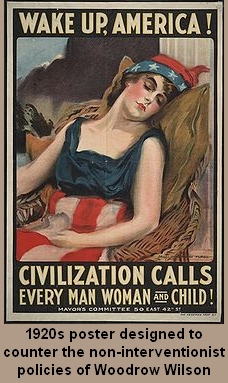 As to America’s willingness to send
its manpower to help better the world, an analysis of this
topic would be a non-discussion, as of all of the countries
of the world everyone on earth knows that America is the
first and the fastest to come to the aid of others. Or so it
has been until we seemed to have forgotten how to care for
our own in Benghazi, seem today to not be aware that tens of
thousand of innocents are dying in Syria for lack of a
strong resolve on America’s part to stand toe to toe against
Russia and Iran, seem not to care that warlords are wielding
crimes against humanity across the world, such as in Mali in
Africa, or seem the least concerned that America's current
administration has embarked on an isolationist,
non-interventionist foreign policy that rivals that of
Woodrow Wilson.
As to America’s willingness to send
its manpower to help better the world, an analysis of this
topic would be a non-discussion, as of all of the countries
of the world everyone on earth knows that America is the
first and the fastest to come to the aid of others. Or so it
has been until we seemed to have forgotten how to care for
our own in Benghazi, seem today to not be aware that tens of
thousand of innocents are dying in Syria for lack of a
strong resolve on America’s part to stand toe to toe against
Russia and Iran, seem not to care that warlords are wielding
crimes against humanity across the world, such as in Mali in
Africa, or seem the least concerned that America's current
administration has embarked on an isolationist,
non-interventionist foreign policy that rivals that of
Woodrow Wilson. 
 Posted 1 June 2013

 The
result: on a proportional basis few if any recruits were won over by the guerillas,
little in the way of weapons made it into their hands, and
even less ammunition... all of which caused them to suffer a
sustained inability to organize anything more than a few
hamlets and villages in each country they targeted. One
example of this can be seen in the Philippines, where because
of the fact that Ho Chi Minh had his hands full with the
Vietnam War he was unable to help the
The
result: on a proportional basis few if any recruits were won over by the guerillas,
little in the way of weapons made it into their hands, and
even less ammunition... all of which caused them to suffer a
sustained inability to organize anything more than a few
hamlets and villages in each country they targeted. One
example of this can be seen in the Philippines, where because
of the fact that Ho Chi Minh had his hands full with the
Vietnam War he was unable to help the