This is the continuation of a story begun on our August 2013 Home Page. To go to an archived version of
that page, click here: August
2013 Home Page Archive. To return to this
month'sactual Home Page, click on the Signal Corps orangeHome Page menu item in the
upper left corner of this page.
continuing...
Foundationally, wire was ideal for supporting three modes of
communication: telegraphy, telephony, and a new form of
communication then coming along called teletyping. As most
of our readers know, telegraphy involves sending messages in
Morse code. The telephone on the other hand, as all know
today but many did not back then, deals with carrying the
human voice over wires, as a means of communication.
Teletypewriters of the kind back in those early days
transmitted messages by printing them out on either inked
paper, or in the form of perforated symbols along a paper
tape. This latter form of printed output held the added
advantage of allowing the teletype operator to use the
paper tape created for multiple transmissions, by inserting it into a paper tape reader
which could then retransmit the message on to other
stations.
What the Signal Corps saw back then was that each of these
forms of wire based communication had advantages for use in
the battlefield, advantages that needed to be preserved if
communication was to evolve from being strictly wire based
to also include radio based forms. And so the Signal Corps
set out to assure that for each of these three methods of
communication there was a radio equivalent under
development.
As development efforts moved forward to find wireless
equivalents of the trinity of telegraphy, telephony and
teletype, it soon became obvious that several new variants
showed promise. The first of these was obviously
radiotelephony, as nothing seemed quite as reassuring to
someone in combat receiving orders than hearing the other
person’s voice on the handset. Because of this,
radiotelephony received most of the research effort the
Signal Corps expended in this area.
Yet while radiotelephony was the darling child of the group,
radiotelegraphy was clearly the easiest to develop from a
technological standpoint, and so while research in other
areas continued the work done with radiotelegraphy moved
along the farthest and fastest. In fact, so quick was the
development process for radiotelegraphy that units able to
be tested in the field were the first to appear, offering
high speed code transmission long before voice telephony was
ready for use.
Following shortly on the heels of both of these,
radioteletype began to move forward, although by the late
1930s it was still considered too new a form of wireless
communication to be taken into account as a possible future
battlefield communication platform.
Instead, wire telegraphy was the dominant communication form
for the battle field, with the six-pound manual telegraph
set TG-5 being one of the most prolific items in use up
through and well into World War II. Part of the reason for
reliance on telegraphy versus telephony came from the fact
that the voltage of telegraphs like the TG-5 could be
increased in order to drive the signal out over a greater
length of wire, or to compensate for poor wires that might
suffer from high resistance points along the length of the
circuit. This could not be done with telephony, which
required a rather precise voltage level, thus making
telephone units
less reliable in field locations. Add to this the fact that
interference had less of an effect on a telegraph signal
than on voice communication, and the fact that while
telegraphy required a trained operator the enemy at least
needed one too, as well as one who spoke English and knew
Morse code, and it was easy to see why most military
commanders trusted their front line communication to
telegraphy.
Further back in the rear however, as the late 30s gave way
to the early 40s and the onset of WWII, wire teletype began
to be replaced the wire telegraph. And not surprisingly,
wherever radio telegraphy made its appearance it pushed out
wire telegraphy for good. The reason was obvious, the battle
space included many areas where wire simply could not be
laid, whether because of the terrain or the enemy. Either
way, sending a radiotelegraph signal up into the air and
over the obstruction provided a no-brains solution to the
problem. Notwithstanding all of this however, wire based
telephony still held its own, and proved the dominant form
of voice communication for the time. Thus as WWII got
underway the U.S. military, and most of its Allies, found
itself depending on wire telephony, wire teletype, and radio
telegraphy for battlefield-to-rear echelon communications.
To keep all of this wire based
communication equipment working, the Signal Corps settled on
a standard “field wire” which it called the W-110. At the
same time, it used a different form of wire for combat field
conditions, calling it “assault wire” and giving it the model number W-130.
Not surprisingly, “field wire” proved heavier and more
durable than “assault
wire.” Either way, both were relatively light in weight, and
composed of twisted pairs. However, the desire to keep the
weight of the wire
as low as possible caused both to exhibit
limited capacity as well as range. On the other hand,
because of their low weight they could easily be laid from
reels carried by trucks, jeeps, or even horses and donkeys.
As an example, a mile of twisted-pair “field wire” weighed
130 pounds, with the same amount of “assault wire” coming in
at only 30 pounds.[1]
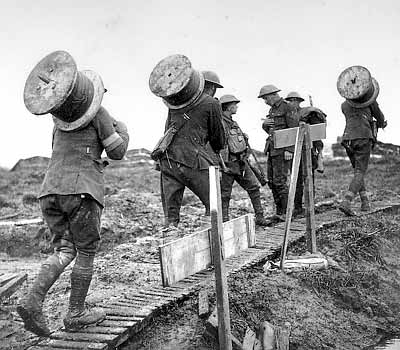
Not surprisingly, the reels the wire was wound on came in
different sizes. On the smaller side, a two man crew could
easily carry one with an axle through it, spinning it as
they walked in order to lay out the wire. Once such axle,
the RL-27A, weighed only 5 pounds. The RL-31 on the other
hand, an A-frame like platform with a hand crank, cross
braces and a brake, weighed 30 pounds. Even larger, the
gasoline-powered RL-26 weighed in at around 600 pounds when
loaded with two miles of W-110, and accordingly needed to be
vehicle mounted for use.
Wire & Wireless Research &
Development
As to the devices connected to field laid wire, on the
telephony side most were battery-powered and operated just
like commercial ones of the time. The most common of these
was the EE-8, EE-8-A, and later the EE-8-B, each a
sound-powered telephone that worked based on the very first
principles Alexander Graham Bell depended on when he
invented the telephone. The first version of these had a
bell, which obviously worked only to give away one’s
position to the enemy… so later versions replaced the bell
with a small light to signal an incoming call. Similarly,
the early versions that came to the field sported well made, strong and
rather handsome leather cases… these soon fell by the
wayside in favor or corded fabric cases, as rationing took
hold during WWII.
Most of these phones were connected to field switchboards,
and while improvements were made in everything from the wire
itself through to reels and the telephone instruments,
little change occurred with regard to the switchboards used.
From the Signal Corps’ standpoint, while some improvements
could surely have been made, there were much more important
areas where technological improvements needed to be
addressed,
and so battlefield switchboards were simply set aside as a
priority. After all, they worked, and everyone knew how to
use them.
Operationally, between the wars and on into WWII, three
primary types of switchboards were used, all spin-offs of
the French models that were prevalent during World War I.
Classified in terms of the number of lines each could
handle, they broke down into a 6 “drop” unit, a 12 drop
unit, and a 40 drop unit.
The BD-71 (“BD” standing for board) had 6 drops. Its larger
cousin, the BD-72, had 12 drops. Both found use as
regimental boards, with the smaller being used at Company
and Battalion levels too. Division level communication
generally fell to the task of a 40-line unit called the
BD-14. From a size perspective, all of these were small in
stature. From a weight standpoint however, all of them were
heavy, as they depended on dry cell storage batteries to
operate; dry cell storage batteries being a necessary
element of the operational aspect of the common battery
system that Bell invented.
Thus, the system worked by powering itself off of both the
local dry cell battery associated with the telephone
instrument at the end of the wire, as well as the battery
associated with the switchboard itself. In fact, that’s
where the term “local battery” came from. If you did not
have a functioning battery on your local instrument… be it
the EE-8 telephone or the BD-71 switchboard… you were not
going to communicate with the person at the other end of the
line.
As most readers know, to make a call the originator cranked
a handle that “rang up” the switchboard operator. Similarly,
once it was determined by the switchboard operator who the
caller wanted to be connected to, he or she would crank up
enough energy on the switchboard to ring the telephone of
the person being called.
As to the term “drop,” it comes from the device that
notified the switchboard operator that there was an incoming
call. Located in a small shutter above the jack opening that
the switchboard operator plugged into to answer or initiate
a call was an electromagnet (a.k.a. solenoid) that, when
energized, dropped the shutter as a signal to the operator
that there was a call. The hand cranking of the telephone on
the other end of the line provided the voltage needed to
energize the electromagnet and release the shutter.
Recognizing that on the upper end, the 40 line capability of
the BD-14 would not be enough to take care of Corps or Army
sized units, the Signal Corps developed larger switchboards
to serve these needs. One of the switchboards the Signal
Corps developed became known as the BD-89, and fit the niche
size of commands that had outgrown traditional Division
sized structure, but were not yet up to the full complement
of a Corps. This unit provided a 60-line capability, yet was
still compact enough to avoid making it necessary to augment
the staff required to operate it.
Built in a modular
fashion, the BD-89 was just one of many examples of how the
Signal Corps brought modern manufacturing to the military
between the wars. By making the unit modular it could be
set up in a small configuration and added onto as the HQ unit
grew. While today this may seem like common sense, back
between WWI and WWII introducing newer forms of thinking to
the art of product development was unheard of, especially in
the military. Not so for the Signal Corps, as we said in the
first part of this article last month, the Signal Corps was
so advanced back then that it may have singlehandedly
changed the outcome of WWII and made America the Superpower
it is today.
To make assembly of a field switchboard easier, the Signal
Corps grouped equipment into sets. Thus for a field army a
set of equipment known as the TC-1 came into being. It
consisted of a switchboard, the BD-80, a BE-70-F test
cabinet, BD-90 power panel, BE-75 AC power distribution
cabinet, BE-72 DC power and test cabinet, RA-36 rectifier,
FM-19 protection panel, and a set of ME-4 maintenance
equipment. Like other modular units the Signal Corps
developed, the TC-1 could be installed in six sections, side
by side until its maximum capacity of 100 lines was
attained. While designed for field combat use, when
installed the unit looked no different than any of the
central office switchboards that could then be seen in any
of the cities the Bell System was serving across America.[2]
Similarly, the equipment that found use in the wire
telegraph and teletypewriter hubs in the military looked for
all practical purposes just like that seen in the offices of
Western Union,
the great 1851 company that set out to and successfully
wired America for telegraphy.
- - - - -
Back in the early 1930s, as the Signal Corps began looking
seriously at how teletypes could be improved for use in
combat, experimentation took place with systems that were
called “telegraph printers” and which printed the message on
paper tape. Later, as page teletypes replaced tape in the
commercial world, the Signal Corps followed along and began
to experiment in this area too. Around about then the term
telegraph printer fell by the wayside, in favor of the more
simple term teletype. To speed its development efforts the
Signal Corps struck research agreements with the Teletype
Corporation, a subsidiary of the American Telephone and
Telegraph Company's Western Electric manufacturing arm. This
company was selected because of several factors, not the
least of which was that it had some of the best equipment
then available, had the backing of the enormous AT&T and
Western Electric companies and their laboratories, and was
closely allied with some of the more powerful industrialists
of the time. After all, a little power politics never hurt
anyone, including the Signal Corps.
In short order what the Signal Corps decided to do was
simply to alter, albeit only slightly, the Model 15–KSR
built by The Teletype Corporation for commercial use and
sale. This new system then became known as the TG-7, and
became a standard for the U.S. military [see picture below].
Having everything needed from a power supply to spare parts,
the TG-7 became the standard element for both the mobile
field teletypewriter, known as the EE-97, and the fixed
equipment teletypewriter, the EE-98. One of the changes that
the Signal Corps required to be made by The Teletype
Corporation to its original 15-KSR design however was to
move to a layout that used what was known as a “neutral
system.”
The neutral system, as opposed to the "polarential
system" used in the 15-KSR, used fewer parts, thus reducing
both wear and tear and the number of breakdowns. Just as
importantly, the changes the Signal Corps requested added to
the speed and accuracy with which the system transmitted
messages. In the case of the TG-7 the neutral system’s
operation alternated pulses of current with breaks when no
current flowed. This caused each letter the transmitting
operator struck on his keyboard to be translated, according
to a five-unit code, into a combination of current flow
(mark) and current break (space). On the other end of the
line, at the receiving teletypewriter, this combination of
codes actuated the same exact corresponding combination of
key strikes, causing a near instantaneous printing of each character. When set
side by side, one could see the nearly instantaneous
reproduction of the message on the receiving unit, in
synchronization with the transmitting
teletypewriter’s keys being struck. Overall, the speed and
accuracy of the system's operation was
impressive.[3]
And so the Signal Corps improved on the
technology of the day—sometimes in small ways, sometimes in
big ways, but always an improvement—improvements born out
of the unique strategic alliances the Signal Corps struck
between the wars with American industry, the country’s
university research facilities, and within the Signal Corps'
own 17 laboratories.
One example of how the Signal Corps turned these alliances
to its advantage can be seen in how it went about fixing one
of the biggest problems it faced in the early development of military field teletypewriters. That problem was the
availability of reliable power, of a type that provided the
stable flow of current needed to assure the integrity of the
“mark-and-space” operation.
Research showed that the AC
cycle rate required for stable operation of a teletypewriter
could be anything between twenty-five Hz and sixty Hz, just
as long as the rate was unvarying. So sensitive was the
system’s operation that a shift of as little as 3% in the
frequency would affect the accuracy of the output being
printed. The reason for this was that the electrical impulses
needed to keep both the sending and receiving printers in
perfect synchronization had to be in synch themselves.
The Signal Corps tried many of the products of the time,
looking for power units that would meet the close tolerance
requirements, but none met the challenge. After testing six
of the more well designed commercial units available, the
Signal Corps set out to design its own. The result was a
field generator that became known as the PE-77, a 70-pound
DC generator that proved extremely reliable. To supplement
this DC version the PE-75 was also introduced. It weighed in
at 300 pounds, and provided commercial grade AC able to
power the EE-97 mobile teletypewriter set.[4]
Conclusion
One can see from all of this how determined the Signal Corps
between the wars was on improving the equipment that would
be available when the next world war rolled around. Since
wire was the primary means of communication used to hold a
battlefield together at that time, and because so much of
the activity that surrounded field combat took place in
rear-area administrative regions, it was only natural that
the Signal Corps gave wire based forms of communication as
much attention as it did. But it did not end there.
As the Signal Corps learned in WWI, the reliance on well
protected rear-areas through which it could safely string
its wire and keep it intact was quickly becoming a thing of
the past. Better artillery, aircraft bombing runs even of
the limited type seen in WWI, and other forms of advanced
combat all combined to cause the Signal Corps to see the
writing on the wall.
To prepare for the next big war, the Signal Corps not only
focused on improving its wireline forms of communication,
but embarked on a whole new program to supplant wire with
wireless. In particular, in that no-man’s land of
communication traffic that fell between Company, Battalion,
Brigade, Division and Corps level combat operations the
Signal Corps found much room for improvement in getting the
message through. To solve the problems it saw, it set about
researching, developing, building and bringing to the field
some of the best radio telephony systems ever introduced.
Next month we will continue this article by looking at the
radio equipment that the Signal Corps brought to combat just
in time for WWII.
Footnotes
[1] For specifications on the types of wire used
by the Signal Corps during WWII, visit this link:
Standard Assault Wire.
- To return to your place in the text click here:
[2] For a list of the various types of Army
telephones, switchboards, and central office sets visit this link:
Army Telephone & Switchboards. - To return to your place in the text click here:
[3] The “neutral system” lacks a relay block,
polar-neutral key, motor control relay, and a terminal block, all of which
are included in the commercial version. The military version also comes
packed in two chests. One chest serves as an operation table for the
printer, and the other as a seat. - To return to your place in the text click here:
[4] The EE-98 was identical to the EE-97 except
that it lacked its own power unit (i.e. the PE-75). Being intended for fixed
use, it was simply plugged into whatever commercial power was available.
- To return to your place in the text click here:
Additional Sources
General information gathered from the following
Signal Corps Information Letters: No. 1 (April, 1934), pp. 7 ff., No.
10 (July, 1936), pp. 13-17, No. 13 (April, 1937), pp. 8-9, No. 15 (October,
1937), p. 7, No. 18 (July, 1938), p. 12, No. 22 (July, 1939), p. 12, No. 24
(January, 1940), p. 9.
Additional general information gathered from Signal
Corps Technical Letters: No. 38 (January, 1945), p. 24.
Data on the structure of the SCL network gathered from
the SCL, Annual Report, 1936, pp. 21-22, 1937, p. 31, 1938, pp. 33
ff., 1939, pp. 42 ff., 1941, pp. 30-31.
Operational information about the Signal Corps
Laboratories gathered from the Historical Report of the Signal Corps
Engineering Laboratories, pp. 149-56, 161-62
Information on the differences in various types of
Signal Corps field wire gathered from a report entitled "Rpt, C&E
Coordination Bd OCSigO to Chief Com Coordination Br, 26 May 42, sub: Case 17
types of W-110 concentric vs. parallel lay” wire tests.
Additional general background information taken
from the report by Major General Roger B. Colton, entitled Army Ground
Communication Equipment, Electrical Engineering, LXIV, No. 5 (May,
1945), pages 173-74.
.
Comment Section
Have a thought on this article? Let us know what it is.
Use your real name or make up a User Name. If you make up a User Name, use
the same one each time you comment on our website, so that our readers will
get to know your views on the world. Don't want to be known? Paranoid? Then
make up a new name each time you comment.
eMail addresses are optional. If you provide one we will add you to our
Scholarship Program mailing list and keep you informed of upcoming
events. What we will not do however... ever, ever, ever... is sell or give
your eMail address to anyone... unless of course the NSA asks for it.
Like this article? Let us know by
helping us with our scholarship fund efforts. A $30.00 donation
to our
Scholarship Fund
will help us get one step closer to helping another deserving High School
graduate attend college. Your donation is tax deductible and your
kindness will go father than you think in making
it possible for another young American to fulfill their dream of a college
education. Thank You!
Original Site Design and Construction
By John Hart, Class 07-66. Ongoing site design and maintenance
courtesy Class 09-67.
Content and design Copyright
1998 - 2013 by ArmySignalOCS.com.







 Foundationally, wire was ideal for supporting three modes of
communication: telegraphy, telephony, and a new form of
communication then coming along called teletyping. As most
of our readers know, telegraphy involves sending messages in
Morse code. The telephone on the other hand, as all know
today but many did not back then, deals with carrying the
human voice over wires, as a means of communication.
Teletypewriters of the kind back in those early days
transmitted messages by printing them out on either inked
paper, or in the form of perforated symbols along a paper
tape. This latter form of printed output held the added
advantage of allowing the teletype operator to use the
paper tape created for multiple transmissions, by inserting it into a paper tape reader
which could then retransmit the message on to other
stations.
Foundationally, wire was ideal for supporting three modes of
communication: telegraphy, telephony, and a new form of
communication then coming along called teletyping. As most
of our readers know, telegraphy involves sending messages in
Morse code. The telephone on the other hand, as all know
today but many did not back then, deals with carrying the
human voice over wires, as a means of communication.
Teletypewriters of the kind back in those early days
transmitted messages by printing them out on either inked
paper, or in the form of perforated symbols along a paper
tape. This latter form of printed output held the added
advantage of allowing the teletype operator to use the
paper tape created for multiple transmissions, by inserting it into a paper tape reader
which could then retransmit the message on to other
stations. 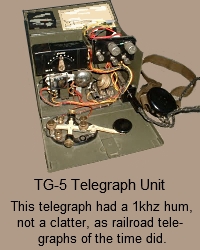 Yet while radiotelephony was the darling child of the group,
radiotelegraphy was clearly the easiest to develop from a
technological standpoint, and so while research in other
areas continued the work done with radiotelegraphy moved
along the farthest and fastest. In fact, so quick was the
development process for radiotelegraphy that units able to
be tested in the field were the first to appear, offering
high speed code transmission long before voice telephony was
ready for use.
Yet while radiotelephony was the darling child of the group,
radiotelegraphy was clearly the easiest to develop from a
technological standpoint, and so while research in other
areas continued the work done with radiotelegraphy moved
along the farthest and fastest. In fact, so quick was the
development process for radiotelegraphy that units able to
be tested in the field were the first to appear, offering
high speed code transmission long before voice telephony was
ready for use. 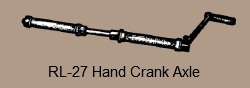 Further back in the rear however, as the late 30s gave way
to the early 40s and the onset of WWII, wire teletype began
to be replaced the wire telegraph. And not surprisingly,
wherever radio telegraphy made its appearance it pushed out
wire telegraphy for good. The reason was obvious, the battle
space included many areas where wire simply could not be
laid, whether because of the terrain or the enemy. Either
way, sending a radiotelegraph signal up into the air and
over the obstruction provided a no-brains solution to the
problem. Notwithstanding all of this however, wire based
telephony still held its own, and proved the dominant form
of voice communication for the time. Thus as WWII got
underway the U.S. military, and most of its Allies, found
itself depending on wire telephony, wire teletype, and radio
telegraphy for battlefield-to-rear echelon communications.
Further back in the rear however, as the late 30s gave way
to the early 40s and the onset of WWII, wire teletype began
to be replaced the wire telegraph. And not surprisingly,
wherever radio telegraphy made its appearance it pushed out
wire telegraphy for good. The reason was obvious, the battle
space included many areas where wire simply could not be
laid, whether because of the terrain or the enemy. Either
way, sending a radiotelegraph signal up into the air and
over the obstruction provided a no-brains solution to the
problem. Notwithstanding all of this however, wire based
telephony still held its own, and proved the dominant form
of voice communication for the time. Thus as WWII got
underway the U.S. military, and most of its Allies, found
itself depending on wire telephony, wire teletype, and radio
telegraphy for battlefield-to-rear echelon communications. 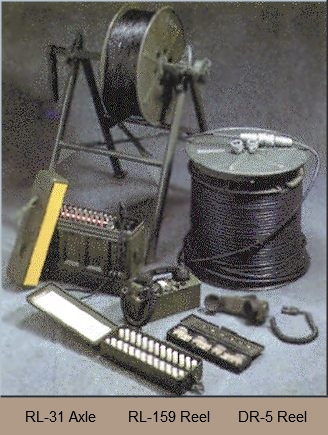 as low as possible caused both to exhibit
limited capacity as well as range. On the other hand,
because of their low weight they could easily be laid from
reels carried by trucks, jeeps, or even horses and donkeys.
As an example, a mile of twisted-pair “field wire” weighed
130 pounds, with the same amount of “assault wire” coming in
at only 30 pounds.
as low as possible caused both to exhibit
limited capacity as well as range. On the other hand,
because of their low weight they could easily be laid from
reels carried by trucks, jeeps, or even horses and donkeys.
As an example, a mile of twisted-pair “field wire” weighed
130 pounds, with the same amount of “assault wire” coming in
at only 30 pounds.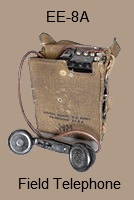 Most of these phones were connected to field switchboards,
and while improvements were made in everything from the wire
itself through to reels and the telephone instruments,
little change occurred with regard to the switchboards used.
From the Signal Corps’ standpoint, while some improvements
could surely have been made, there were much more important
areas where technological improvements needed to be
addressed,
and so battlefield switchboards were simply set aside as a
priority. After all, they worked, and everyone knew how to
use them.
Most of these phones were connected to field switchboards,
and while improvements were made in everything from the wire
itself through to reels and the telephone instruments,
little change occurred with regard to the switchboards used.
From the Signal Corps’ standpoint, while some improvements
could surely have been made, there were much more important
areas where technological improvements needed to be
addressed,
and so battlefield switchboards were simply set aside as a
priority. After all, they worked, and everyone knew how to
use them. 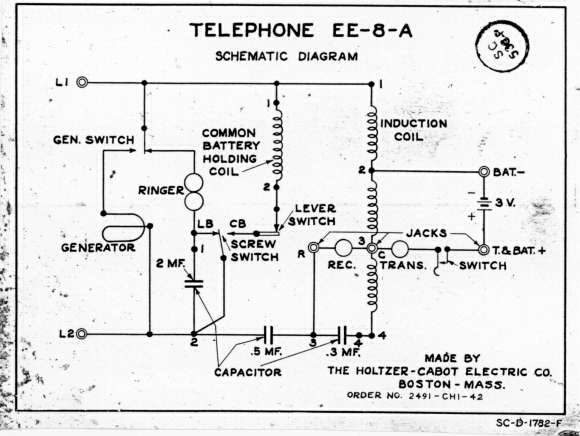 The BD-71 (“BD” standing for board) had 6 drops. Its larger
cousin, the BD-72, had 12 drops. Both found use as
regimental boards, with the smaller being used at Company
and Battalion levels too. Division level communication
generally fell to the task of a 40-line unit called the
BD-14. From a size perspective, all of these were small in
stature. From a weight standpoint however, all of them were
heavy, as they depended on dry cell storage batteries to
operate; dry cell storage batteries being a necessary
element of the operational aspect of the common battery
system that Bell invented.
The BD-71 (“BD” standing for board) had 6 drops. Its larger
cousin, the BD-72, had 12 drops. Both found use as
regimental boards, with the smaller being used at Company
and Battalion levels too. Division level communication
generally fell to the task of a 40-line unit called the
BD-14. From a size perspective, all of these were small in
stature. From a weight standpoint however, all of them were
heavy, as they depended on dry cell storage batteries to
operate; dry cell storage batteries being a necessary
element of the operational aspect of the common battery
system that Bell invented. 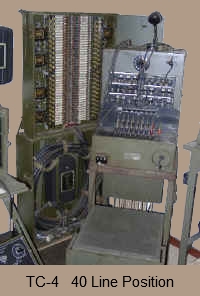 Recognizing that on the upper end, the 40 line capability of
the BD-14 would not be enough to take care of Corps or Army
sized units, the Signal Corps developed larger switchboards
to serve these needs. One of the switchboards the Signal
Corps developed became known as the BD-89, and fit the niche
size of commands that had outgrown traditional Division
sized structure, but were not yet up to the full complement
of a Corps. This unit provided a 60-line capability, yet was
still compact enough to avoid making it necessary to augment
the staff required to operate it.
Recognizing that on the upper end, the 40 line capability of
the BD-14 would not be enough to take care of Corps or Army
sized units, the Signal Corps developed larger switchboards
to serve these needs. One of the switchboards the Signal
Corps developed became known as the BD-89, and fit the niche
size of commands that had outgrown traditional Division
sized structure, but were not yet up to the full complement
of a Corps. This unit provided a 60-line capability, yet was
still compact enough to avoid making it necessary to augment
the staff required to operate it. 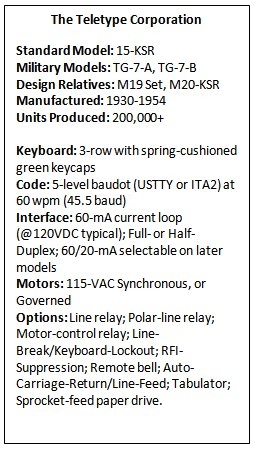 Back in the early 1930s, as the Signal Corps began looking
seriously at how teletypes could be improved for use in
combat, experimentation took place with systems that were
called “telegraph printers” and which printed the message on
paper tape. Later, as page teletypes replaced tape in the
commercial world, the Signal Corps followed along and began
to experiment in this area too. Around about then the term
telegraph printer fell by the wayside, in favor of the more
simple term teletype. To speed its development efforts the
Signal Corps struck research agreements with the Teletype
Corporation, a subsidiary of the American Telephone and
Telegraph Company's Western Electric manufacturing arm. This
company was selected because of several factors, not the
least of which was that it had some of the best equipment
then available, had the backing of the enormous AT&T and
Western Electric companies and their laboratories, and was
closely allied with some of the more powerful industrialists
of the time. After all, a little power politics never hurt
anyone, including the Signal Corps.
Back in the early 1930s, as the Signal Corps began looking
seriously at how teletypes could be improved for use in
combat, experimentation took place with systems that were
called “telegraph printers” and which printed the message on
paper tape. Later, as page teletypes replaced tape in the
commercial world, the Signal Corps followed along and began
to experiment in this area too. Around about then the term
telegraph printer fell by the wayside, in favor of the more
simple term teletype. To speed its development efforts the
Signal Corps struck research agreements with the Teletype
Corporation, a subsidiary of the American Telephone and
Telegraph Company's Western Electric manufacturing arm. This
company was selected because of several factors, not the
least of which was that it had some of the best equipment
then available, had the backing of the enormous AT&T and
Western Electric companies and their laboratories, and was
closely allied with some of the more powerful industrialists
of the time. After all, a little power politics never hurt
anyone, including the Signal Corps. 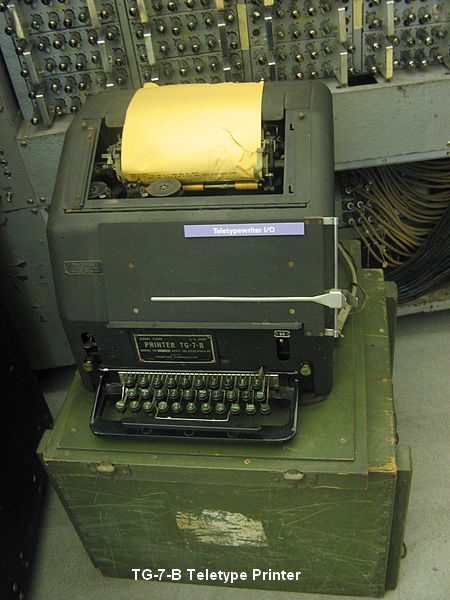 And so the Signal Corps improved on the
technology of the day—sometimes in small ways, sometimes in
big ways, but always an improvement—improvements born out
of the unique strategic alliances the Signal Corps struck
between the wars with American industry, the country’s
university research facilities, and within the Signal Corps'
own 17 laboratories.
And so the Signal Corps improved on the
technology of the day—sometimes in small ways, sometimes in
big ways, but always an improvement—improvements born out
of the unique strategic alliances the Signal Corps struck
between the wars with American industry, the country’s
university research facilities, and within the Signal Corps'
own 17 laboratories.