Continued from the June 2012 Home Page. To go to an archived version of
that page, click here:
June
2012 Home Page Archive. To return to this
month's actual Home Page, click on the Signal Corps
orange Home Page menu item in
the upper left corner of this page.

continuing...
That technology shapes warfare not war is easier to see
today than it was back during WWII, and certainly much
easier than it was during WWI.
Like the air we breathe and the water we drink, it is
unfortunate but true that for as long as Homo erectus has
been around, so hasn’t war. It is timeless and universal.
The fact that our species has used it as a tool to impact
society’s development for over 1.6 million years, since we
first started walking upright, makes one wonder if all of
the cries for peace coming from the liberal left isn’t just
one big waste of time? Does anyone really believe that the
mere act of wanting a world at peace is going to bring one?
Does anyone really think that if one element of society
gives up war, all the others will too? Haven’t the wars
stemming from religious intolerance made the case that man
has found a way to usurp even the most beautiful part of
man’s thoughts—belief in a good and peaceful God—such that
rather than religion being a cause for good, it now has
become a cause for war? Let’s face it, war is here to stay.
If so, then what of technology’s impact on it?
Ahhhh… we got you. You see, that’s a trick question. It’s a
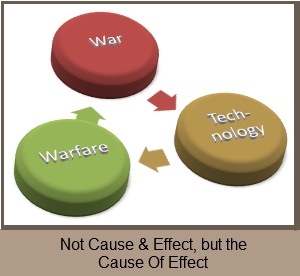
trick question because if one looks at the graphic below,
one will see that technology has no impact on war. Instead,
it’s impact is on warfare.
 What’s
the difference, you ask? Consider this: our current
President is busy trying to reduce America’s stockpile of
nuclear weapons. He’s also busy shelving the research Reagan
started into ways and means of shooting down ICBMs and other
offense postured missiles (especially during their boost
stage) and satellites. If our premise here that war impacts
technology, and technology impacts warfare, and warfare
impacts war is right, then doing away with nuclear weapons
or missile defense shields isn’t going to do a darn thing
when it comes to stopping or preventing war. All it is going
to do is impact our ability to fight it when it inevitably
comes.
What’s
the difference, you ask? Consider this: our current
President is busy trying to reduce America’s stockpile of
nuclear weapons. He’s also busy shelving the research Reagan
started into ways and means of shooting down ICBMs and other
offense postured missiles (especially during their boost
stage) and satellites. If our premise here that war impacts
technology, and technology impacts warfare, and warfare
impacts war is right, then doing away with nuclear weapons
or missile defense shields isn’t going to do a darn thing
when it comes to stopping or preventing war. All it is going
to do is impact our ability to fight it when it inevitably
comes.
Look at the graphic and you can see that being without nukes
or missile defense systems won’t deter an aggressor from
attacking… to the contrary, it might even incent one to
attack sooner. But it most definitely will impact how we
fight any such war that an aggressor might start. A weak
military posture invites strong actions against us by those
who oppose us. And if we toss our best technology into the
scrap heap of history, all this will do is multiply the
strong response by those who oppose us by a factor of five
or more. The increase in the strength of their response will
be exponential folks, not linear.
To be clear, by warfare we mean the conduct of war. In other
words, the broil and scrimmage of arms in the field, or the
deployment and management of armed forces in the exercise of
conflict. Warfare entails what we learned of in OCS as
operations, whether or not it involves engaging opposing
forces directly, or via some other organized form of
violence, kinetic, or non-kinetic action.
War on the other hand is little more than a condition. It is
the condition of circumstance that a state or government
finds itself in. While warfare (i.e. the physical activity
conducted by armed forces in the context of war) can
determine the final condition of circumstance that a
government may be saddled with when a war is over, the fact
that a country or people are in a state of war cannot
determine the mode of warfare that is used to impact the
final result of the conflict. Only technology can do that.
So, in the end, if a country wants to have control over the
final state it finds itself in when a war ends, then it has
to develop a credible means to conduct warfare. And if the
desire is to be able to use warfare in a credible manner to
impact the end state of a war, then that same country needs
to master the use of technology to underwrite its mode of
warfare… emerging technology in particular.
By now our astute readers will ask, What about diplomacy?
Can’t it be used to win a war or affect its outcome? Why
only warfare?
 Clearly,
the answer is yes, diplomacy can impact the final state of a
war. However, unlike von Clausewitz, we would not say that
“war is an expression of politics by another means,” instead
we would say that politics (i.e. diplomacy) is an expression
of war by another means. In other words, diplomacy, or what
von Clausewitz calls politics, is in reality just another
method of warfare. Our point then being that warfare is the
overarching entity that determines society’s advance, not
politics.
Clearly,
the answer is yes, diplomacy can impact the final state of a
war. However, unlike von Clausewitz, we would not say that
“war is an expression of politics by another means,” instead
we would say that politics (i.e. diplomacy) is an expression
of war by another means. In other words, diplomacy, or what
von Clausewitz calls politics, is in reality just another
method of warfare. Our point then being that warfare is the
overarching entity that determines society’s advance, not
politics.
We say this because in our view the methods of political
control over people that have come and gone through the ages
have had less of an impact on society’s advancement than
warfare has. Everything from dictatorships, monarchies,
empires, and strange things like the old Hanseatic League
through to internal revolutions, anarchy, democracy,
communism, socialism, Marxism, Leninism, Mao Tse Tung's
thought, the teachings of Che Guevera, and much, much more
has been tried. And one by one they have all fallen by the
wayside or failed at giving people what they want. The only
thing that has remained consistent throughout time has been
the use of warfare to gain for a society that which it could
not gain by political means. Unlike politics, warfare has
proven its enduring ability to either protect or restore to
a people the form of society that they wish to live in.
Don’t mistake what we are saying here. We are not saying
that war is good, only that if one looks again at the "Cause
Of Effect" graphic above one will easily see that diplomacy,
politics, and the state a country or society exists in are
all impacted by technology.
This moves us to our next point: understanding what the
impact of technology is on warfare.
Since wording is important in our making our case, let us
say with specificity what we mean by the impact of
technology on warfare. Here we mean that technology defines,
rules, restricts, and demarcates how a war is fought. It
presages how warfare will take place, and once warfare
begins it (i.e. technology) becomes the instrument of
warfare.
If forced to distill all of this into one word, the greatest
impact technology has on warfare is that it alters it.
Referring back to our discussion above about politics and
diplomacy, one can see that if diplomacy is just another
form of technology, then as it evolves it too can impact how
a war is fought. That is, thinking of a new form of
diplomacy as merely an emerging form of an existing
technology, one can see (and even hope) that perhaps it
might be able to take the rough edges off of the conduct of
a given war… perhaps even to the point of resolving the war
in an end state that the people of both sides can approve
of. But, if this new “diplomatic technology” proves unable
to win the war, then the combatants had better hope that
their “other technologies” are up to the task… or else one
side or the other will find itself in the position of the
Third Reich at the end of WWII.
All in all then, technology both provides and is the chief
source of military advancement, i.e. the advancement of
warfare. And yes, we include diplomacy and politics within
the term “military.” Technology impels changes in warfare
more than any other factor, but it does not determine
warfare. Underneath it all, warfare is impacted and
greatly enabled by technology, but without technology
warfare will continue to exist. The reason is that what we
commonly refer to as the “principles of war” exist
regardless of whether technology evolves or doesn’t… or for
that matter even exists, and in the end it’s the principles
of war that determine warfare. What do we mean by the
principles of war?
In our case the term principles of war refers to the body of
knowledge that a commander needs to know to conduct warfare.
Strategy and tactics are included here, as are those
elements that comprise a commander’s understanding of how to
wage warfare. Among these are included the concepts of
friction, the fog of war, chance, violence, intelligence,
use of terrain, the element of surprise, maneuver, maximum
advantage, planning, critical mass, economy of force,
intelligence and communication security, concentration of
force, overwhelming force, convergent attacks, command and
control, unity of command, and much, much more. From this we
can see that technology defines warfare, but it does not
determine how it is fought. It presides in warfare, but it
does not rule warfare.
So what does rule warfare and determine the outcome of war?
For that answer, we are afraid you will have to come back
next month when we continue our discussion with the Effect
of Technology on Human Agency. Clearly, from this little
hint you can see that in our view Human Agency, brought to
bear on warfare, determines both the sate of and outcome of
war. How well it does this is in great measure determined by
how well Human Agency utilizes the emerging technologies at
its disposal to modify and implement a more effective mode
of warfare
Next Month: Human Agency And Technology Create Winning Warfare
- - - Epilogue - - -

As Raphael demonstrated in 1509, Causal Power is intrinsic to “Prime Mover”
status. In the world we live in today, having Causal Power is an ontological
feature of being human. Restating this, one could say that in many cases
human beings hold Causal Power and therefore are able to exercise it in ways
able to change the existing world. One such way is by acting on technology
to become its Prime Mover. Much as early believers in 1509 thought God did
when setting the universe first in place and then in motion, people today
use Human Agency as the Prime Mover force to leverage technology to alter
the heavens. Not by filling them with stars, but with society-altering
armament.
Human Agency, acting on technology, allows the creation of new forms of
warfare, which have the capability of affecting and altering the end
condition of war.
Adding to this theory of critical realism is the opposing axiom that
regardless of the number of society altering arms one set of Prime Mover's
can place in the heavens, other Prime Movers will be able to leverage
technology to defeat their utility... if, that is, they understand that
technology shapes warfare, and they have used every mode of emerging
technology that they can get their hands on to open as many doors to Human
Agency as possible.
With this in mind, it makes one wonder: how much wisdom is there in reducing
the size of a nation's nuclear arsenal, or shuttering its missile defense
shield research, merely to make the rest of the world feel better?
Have a comment on this article? Send it
to us. If you are a member of the Association we will
gladly publish it.
If you are not, well, it only costs
$30.00 a year to become a member and have your views heard...
and because
we are a fully compliant non-profit organization, your payment is tax
deductable.





 -
- - - - - -
-
- - - - - -